
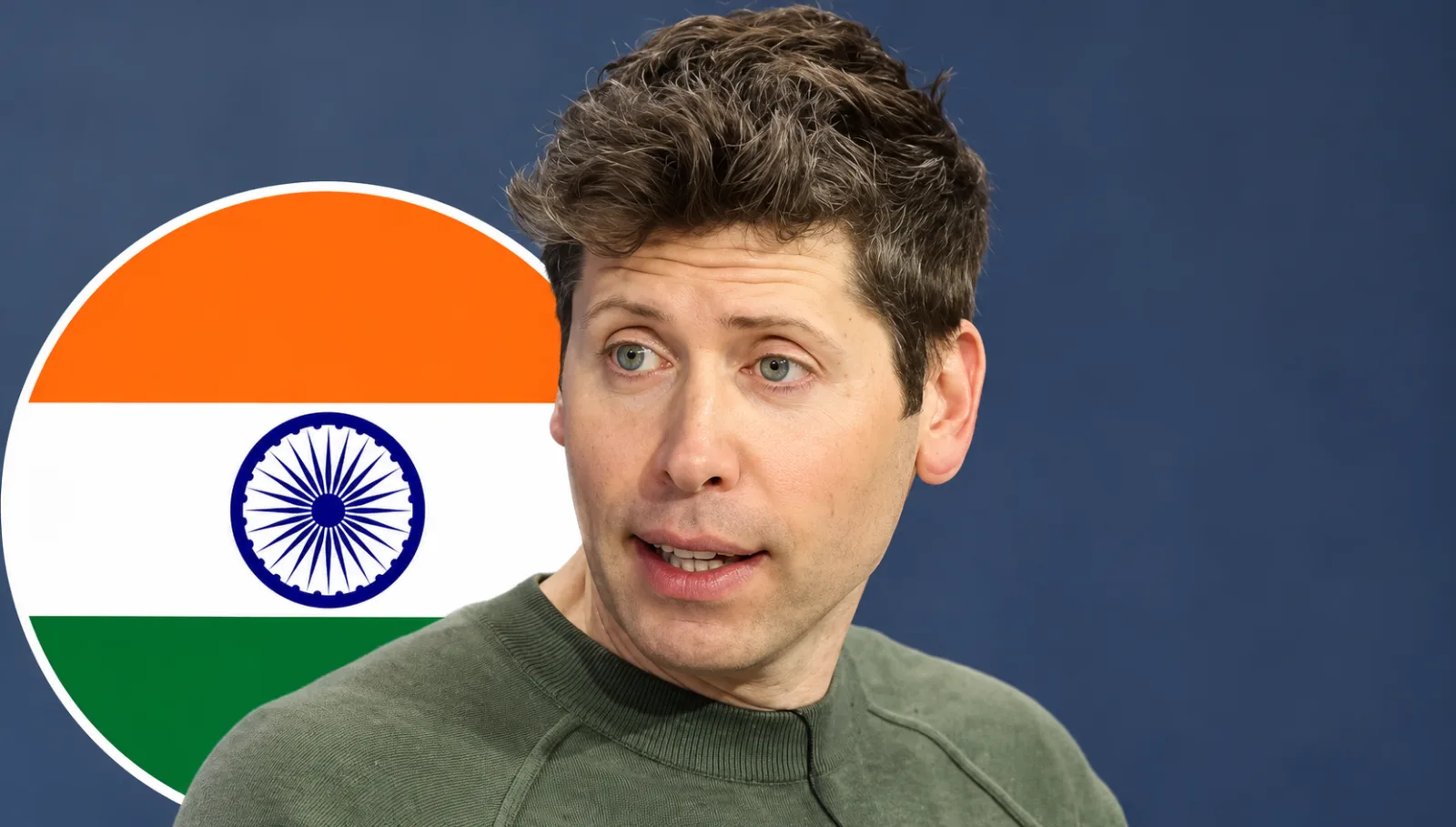
India has become ChatGPT’s largest market globally by weekly active users, overtaking the United States as adoption accelerates across students, professionals, entrepreneurs and businesses. OpenAI says its Indian user base has doubled since January 2026, marking a major shift in the geography of global AI adoption.
India has crossed another major milestone in the global artificial intelligence race.
OpenAI India Managing Director Prabhjeet Singh has confirmed that India is now ChatGPT’s largest market in the world by weekly active users, with the country's user base doubling since January 2026.
OpenAI CEO Sam Altman separately confirmed the scale of the shift during a conversation with entrepreneur Raj Shamani, saying India now has more ChatGPT users than the United States.
For a technology developed in Silicon Valley, that is a remarkable reversal.
The world's biggest ChatGPT user base is now in India.
From No. 2 to No. 1 in Months
India's growth has been extraordinarily fast.
In February 2026, OpenAI said India had already crossed 100 million weekly ChatGPT users, making it the company's second-largest market at the time.
Less than nine months later, India had moved into the top position globally.
OpenAI has not disclosed the latest absolute number of Indian users, so the doubling claim should not simply be interpreted as 200 million without a confirmed January baseline.
But the direction is clear.
India is not merely participating in the AI boom.
It is becoming one of its largest centres of adoption.
Altman Sees ‘Builder Energy’ in India
Altman has repeatedly highlighted a major difference between how Indians and Americans are approaching artificial intelligence.
Speaking with Raj Shamani, he described Indians as far more optimistic about AI and pointed to what he called an extraordinary “builder energy” among users in the country.
That distinction matters.
ChatGPT adoption in India is increasingly moving beyond casual experimentation.
People are using AI to build businesses, write software, study, analyse information, automate work, create content, solve operational problems and complete tasks that previously required specialised expertise.
Altman cited the example of an Indian student who had never organised a fundraising campaign before, but used OpenAI tools to handle the process end to end.
That is where AI becomes economically important.
Not when people simply ask it questions.
But when people begin using it to do things they previously could not do.
India Has the Scale AI Companies Cannot Ignore
India's rise as ChatGPT's largest market reflects several structural advantages.
The country has one of the world's largest internet-connected populations, a huge base of students and developers, a rapidly digitising economy and millions of small businesses that can potentially benefit from inexpensive AI tools.
India also has something even more important: scale.
A product that works across Indian languages, devices, education levels and business environments is being tested against one of the most complex consumer markets anywhere in the world.
That is strategically valuable for global AI companies.
OpenAI has already responded by increasing its commitment to India.
In February, the company launched OpenAI for India, saying the country had surpassed 100 million weekly ChatGPT users and describing India as a major centre for AI adoption.
OpenAI has also expanded its local presence, announced infrastructure and enterprise partnerships, and placed greater emphasis on Indian-language capabilities.
Usage Is Only the First Stage
Becoming the world's largest ChatGPT market is significant.
But India should not confuse AI consumption with AI leadership.
The next challenge is converting massive usage into domestic capability.
That means Indian startups building foundation models.
Indian companies building AI products.
Indian engineers developing inference systems and agent platforms.
Indian data centres providing the compute.
Indian-language datasets improving models for local users.
Indian enterprises using AI to increase productivity.
And Indian researchers producing technologies that can compete globally.
Companies such as Sarvam AI are already pushing in that direction with homegrown models and enterprise AI systems.
The goal should be larger still.
India should not remain the world's biggest customer for AI. It should become one of the world's biggest builders of AI.
A Massive Economic Opportunity
India's enthusiasm toward AI could become an economic advantage if adoption translates into productivity.
AI can give an individual developer capabilities that once required a larger engineering team.
It can allow small businesses to automate customer support, marketing, research and administration.
Students can access personalised learning.
Professionals can analyse information faster.
Entrepreneurs can prototype products with far less capital than before.
This matters particularly in a country where millions of people are entering the digital economy every year.
AI lowers the cost of knowledge and capability.
At India's population scale, even relatively small productivity improvements can become economically significant.
But the opportunity comes with challenges.
India still needs greater domestic computing capacity, stronger AI research, reliable Indian-language systems, better digital skills and clearer frameworks around safety, privacy and data.
Mass adoption is the beginning of the race, not the finish line.
India Is Becoming Central to the Global AI Story
For decades, the world's biggest technology platforms were overwhelmingly designed, launched and initially scaled in the United States.
AI is beginning to reveal a different pattern.
The technology may still be led by American frontier laboratories, but some of its largest user populations are emerging elsewhere.
India is now at the centre of that shift.
More than 100 million Indians were already using ChatGPT weekly by February.
The user base has since doubled from its January level.
India has overtaken the United States in ChatGPT users.
And OpenAI's leadership is openly pointing to the enthusiasm and builder culture emerging from the country.
That is not merely a statistic.
It signals where the next generation of AI users, developers, entrepreneurs and businesses may come from.
India has already become the world's largest ChatGPT market.
The bigger challenge now is turning the world's largest AI user base into one of the world's strongest AI ecosystems.
Sources
- OpenAI - Introducing OpenAI for India - OpenAI's February 18, 2026 announcement confirming more than 100 million weekly ChatGPT users in India and outlining its expansion in the country.
- The Economic Times - Deep Use Cases Vault India to ChatGPT's Top Global Market - Reports OpenAI India MD Prabhjeet Singh's confirmation that India became ChatGPT's largest market by weekly active users and that the Indian user base doubled since January 2026.
- India Today - Sam Altman Says India Has Overtaken the US as ChatGPT's Biggest Market - Reports Altman's confirmation that India has more ChatGPT users than the United States and his comments on Indian enthusiasm for AI.
- NDTV Profit - What Makes India ChatGPT's Biggest Market? - Covers Altman's comments on India's “builder energy” and the practical ways Indian users are applying ChatGPT.
- OpenAI - How ChatGPT Adoption Has Expanded - OpenAI research showing rapid ChatGPT adoption growth across Asia and increasing global use of AI for work, learning and everyday tasks.