
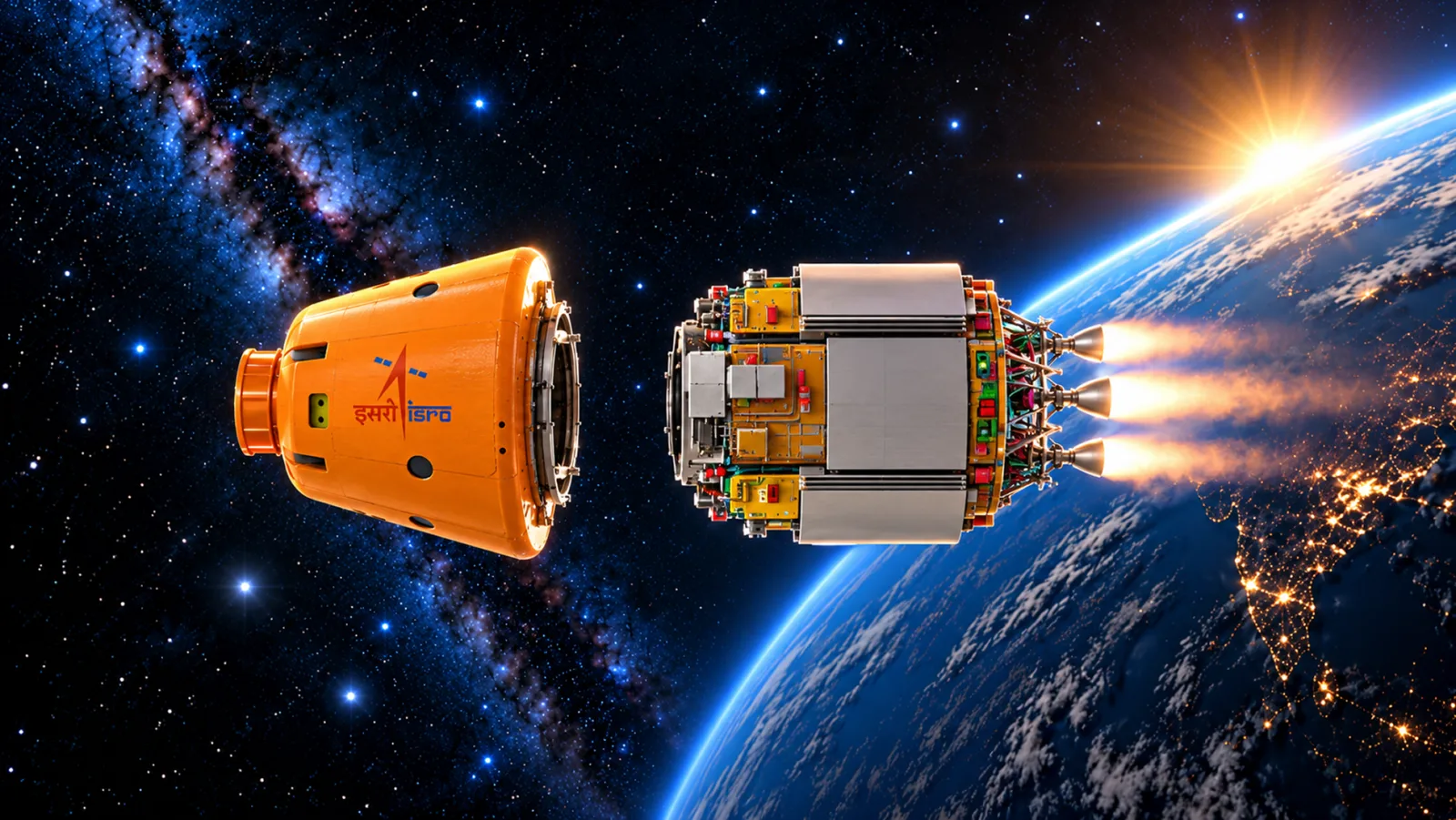
ISRO has successfully validated the separation of Gaganyaan's Crew Module from its Service Module, confirming the reliability of critical spacecraft systems ahead of India's first uncrewed G1 mission, targeted for 2026.
The Indian Space Research Organisation (ISRO) has achieved another major milestone in India's human spaceflight programme, successfully completing a series of Crew Module-Service Module (CM-SM) separation tests for Gaganyaan.
Announced on October 16, 2026, the tests were conducted at the Vikram Sarabhai Space Centre (VSSC) in Thiruvananthapuram. They validated the mechanism responsible for separating the Crew Module from the Service Module before atmospheric re-entry, a critical operation for ensuring the spacecraft's safe return to Earth.
The tests also demonstrated that essential onboard systems, including avionics, navigation equipment and thermal protection components, could withstand the mechanical shocks generated during separation.
The achievement strengthens confidence in the upcoming Gaganyaan G1 mission, India's first uncrewed flight under the programme, currently targeted for launch in 2026.
Why the Separation Tests Are Critical
Gaganyaan's Orbital Module consists of two primary components: the Crew Module, designed to accommodate astronauts, and the Service Module, which provides propulsion and other essential support functions during flight.
Both remain connected throughout launch and orbital operations. Before atmospheric re-entry, however, the Crew Module must separate from the Service Module through a precisely coordinated sequence involving pyrotechnic mechanisms, jettisoning systems and the severing of electrical and fluid connections.
Any malfunction during this operation could compromise spacecraft stability, onboard electronics or subsequent re-entry procedures.
To validate the system, ISRO developed an extensively instrumented test configuration at VSSC, simulating the integrated Crew Module-Service Module assembly and its separation sequence.
The successful tests confirmed the design adequacy of the separation system and demonstrated the shock survivability of multiple critical subsystems.
What ISRO Successfully Validated
According to ISRO's official announcement, the tests demonstrated the robustness of several important Crew Module systems:
- Avionics Systems: Essential electronic equipment supporting spacecraft operations.
- Inertial Navigation Systems: Critical components responsible for spacecraft orientation and navigation.
- Thermal Protection System: Components incorporated into the aft and conical heat shields.
- Deployable Umbilical Shield: The mechanism associated with protecting the Crew Module's umbilical interface.
- Crew Module Uprighting System: Associated pyrotechnic devices supporting the spacecraft's post-splashdown orientation.
- Thermal and Humidity Control System: Associated pyrotechnic components involved in spacecraft environmental management.
These validations are especially important because separation events generate sudden mechanical shocks that sensitive spacecraft equipment must survive without compromising mission safety.
ISRO stated that the successful tests provide "necessary confidence" in the functioning of the separation system for the upcoming G1 mission.
Gaganyaan's Progress Towards G1
The latest achievement follows several other major qualification milestones completed by ISRO.
In July 2026, the agency successfully conducted tests involving the Crew Module Uprighting System, umbilical separation mechanisms and structural qualification for apex cover separation loads.
The apex cover structural test demonstrated that the Crew Module could withstand approximately 1.75 times the estimated reaction loads, validating its required structural design margins.
Earlier, ISRO had also completed qualification activities for the Crew Module and Service Module propulsion systems.
The Crew Module Propulsion System incorporates 12 thrusters, each generating 100 Newtons of thrust, to provide three-axis control during descent and re-entry following Service Module separation.
In a July 2026 parliamentary response, the Department of Space confirmed that the propulsion stages and structures of the Human Rated Launch Vehicle had completed development and ground testing.
The successful TV-D1 crew escape test and Integrated Air Drop Tests have further contributed to validating Gaganyaan's safety and recovery architecture.
With the latest separation tests completed, ISRO has cleared another important qualification milestone. However, final G1 launch readiness remains subject to the completion of the remaining integration, testing and operational requirements.
The Tathya Analysis: India's Human Spaceflight Ambitions Are Becoming Technological Reality
The successful separation tests represent more than an isolated engineering achievement. They demonstrate India's growing ability to develop and validate complex technologies essential for independent human spaceflight.
Gaganyaan is not merely about sending Indian astronauts into orbit. It is about building India's indigenous capability to undertake human spaceflight missions without depending on another nation for the core mission architecture.
Human spaceflight demands considerably higher safety and reliability standards than conventional satellite operations. Critical systems must function together under demanding conditions, including launch, orbital operations, separation, atmospheric re-entry and recovery.
Each successful qualification test strengthens India's technical understanding of these challenges while reducing uncertainty before actual flight.
Strengthening India's Technological Sovereignty
Gaganyaan is contributing to the development of domestic expertise in spacecraft propulsion, avionics, navigation, thermal protection, structural engineering and mission safety.
These capabilities can support India's broader aerospace and space technology ecosystem, including future orbital infrastructure and advanced exploration missions.
The programme also aligns with India's long-term ambitions to establish the Bharatiya Antariksh Station and progressively expand its human presence in space.
Importantly, ISRO's emphasis on testing individual components before integrated flight operations reflects a disciplined approach in which mission reliability takes precedence over ambitious schedules.
A Step Towards India's Independent Human Spaceflight Capability
India has already established itself as a major spacefaring nation through missions such as Chandrayaan-3, Aditya-L1 and the Mars Orbiter Mission.
Gaganyaan represents the next stage of that development: transitioning from successful robotic space exploration towards independent human spaceflight capabilities.
The latest CM-SM separation tests bring the country another step closer to that objective.
The immediate challenge is to successfully execute the uncrewed G1 mission and validate the complete flight and recovery sequence.
The larger ambition is to establish a sustainable technological foundation for future Indian human spaceflight missions.
For ISRO, this is another successful qualification test. For India, it is another step towards becoming a nation capable of independently sending its astronauts into space and bringing them safely home.
Sources
- Indian Space Research Organisation (ISRO) - ISRO Successfully Completes Crew Module-Service Module Separation Tests for Gaganyaan Programme, October 16, 2026.
- Press Information Bureau, Department of Space - Parliament Question: Gaganyaan Programme, July 29, 2026.
- Indian Space Research Organisation (ISRO) - Liquid Propulsion Systems Integrated on Crew Module for First Uncrewed Gaganyaan Mission, January 22, 2025.