
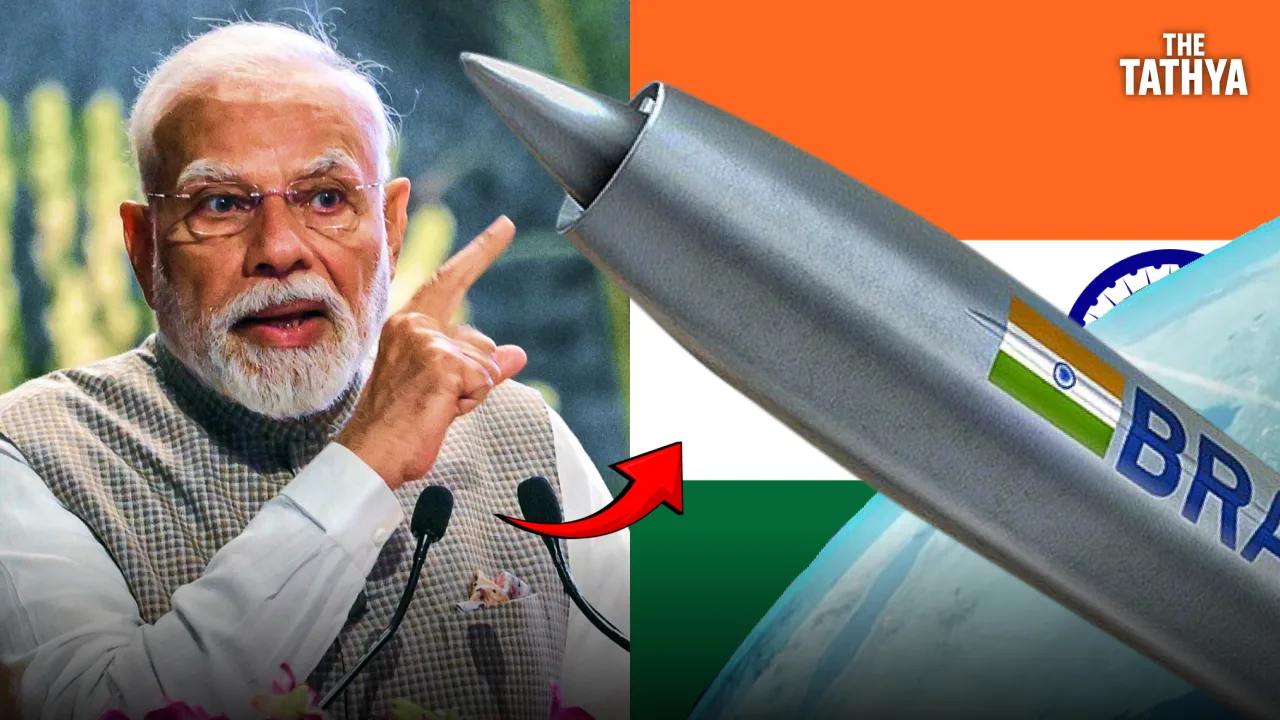
India expects BrahMos exports to exceed $600 million as the Philippines, Vietnam and Indonesia emerge as Southeast Asian customers. The value is still small compared with the global arms market, but the significance lies elsewhere: India is beginning to export a high-end strategic weapon that creates long-term military, industrial and diplomatic relationships.
BrahMos is becoming the clearest example yet of India’s attempt to move from exporting defence components and ammunition to supplying complete strategic weapon systems.
Defence Secretary Rajesh Kumar Singh said on October 1 that exports of the supersonic cruise missile are expected to cross $600 million, with the Philippines, Vietnam and Indonesia forming the first group of overseas customers.
According to Singh, BrahMos systems worth around $330 million have already been delivered to the Philippines, while exports to Vietnam are expected to begin at roughly $100 million and Indonesia at around $200 million. Together, those figures would take the programme to approximately $630 million in exports or planned exports.
The figure requires some context. The Philippines signed a broader $375 million contract in January 2022 for three batteries of the shore-based anti-ship missile system. Singh’s $330 million figure refers to systems delivered rather than the original total contract value.
Vietnam’s BrahMos agreement was confirmed by Singh in May 2026, although detailed contract terms have not been publicly released. Indonesia subsequently became the third Southeast Asian customer in July, when agreements involving both BrahMos and India’s Astra air-to-air missile were announced during Prime Minister Narendra Modi’s visit to Jakarta.
The emerging export map is therefore no longer based on prospective discussions alone. India now has one delivered BrahMos customer and two additional Southeast Asian governments with agreements or contracts involving the system.
From One Philippine Contract to a Regional Export Footprint
The Philippines was the breakthrough.
BrahMos Aerospace signed its first major international contract with Manila in January 2022 for the shore-based anti-ship missile system. Deliveries began in April 2024, giving the Philippine Marine Corps a new coastal anti-ship capability.
The deal mattered far beyond its dollar value.
Until then, India’s growing defence-export numbers were supported heavily by components, protective equipment, ammunition, naval vessels and other systems. BrahMos demonstrated that India could export a technologically complex precision-strike weapon carrying significant strategic value for the buyer.
Vietnam broadened that story.
Defence Secretary Singh publicly confirmed in May 2026 that India had signed an agreement to supply BrahMos to Hanoi. Vietnam has not publicly disclosed the complete configuration, number of systems or final contract value.
Indonesia followed in July. Reuters reported that India would supply Jakarta with BrahMos and Astra missiles following agreements concluded during Modi’s visit. Indian Express subsequently reported that the BrahMos component involved two batteries valued at about $200 million.
This makes Indonesia the third Southeast Asian country to move towards acquiring BrahMos after the Philippines and Vietnam.
The geography is important. All three are maritime Southeast Asian states with significant interests in coastal defence, sea-lane security and maintaining the ability to deter hostile naval forces.
That does not mean the three purchases amount to a coordinated military bloc or an Indian attempt to build a missile network against any specific country. The agreements are bilateral, and each government has its own security calculations.
But the pattern does show that BrahMos has found a natural export market among states looking for powerful land-based maritime strike capabilities.
Why BrahMos Is Different From an Ordinary Defence Export
BrahMos is jointly developed by India’s DRDO and Russia’s NPO Mashinostroyenia through BrahMos Aerospace.
The system is operational with the Indian Army, Navy and Air Force and exists in multiple configurations. BrahMos Aerospace lists land-based, ship-based and air-launched systems, while a submarine-launched configuration has also been developed.
For an overseas customer, this creates the possibility of purchasing more than a single missile.
A coastal battery includes launch vehicles, command systems, missiles, support equipment and training. Maintaining the capability over decades requires maintenance, replacement rounds, technical support, upgrades and potentially additional batteries.
That makes high-end defence exports fundamentally different from most commercial exports.
The initial contract creates a continuing relationship between the armed forces of the buyer and the supplier.
This is one reason Singh described BrahMos as a benchmark for India’s defence-export story. A country purchasing BrahMos becomes dependent to some degree on India and the BrahMos joint venture for training, lifecycle support, replenishment and future modernisation.
For India, that creates both export revenue and strategic influence.
Operation Sindoor Adds a New Marketing Dimension
BrahMos also now carries something that Indian defence systems historically struggled to demonstrate in export markets: claimed operational use in conflict.
The Ministry of Defence has publicly stated that BrahMos was used during Operation Sindoor, India’s 2025 military operation against targets in Pakistan.
Defence Minister Rajnath Singh later described the operation as practical proof of the missile’s capability. Defence Secretary Singh similarly pointed to BrahMos having been “proven in battle” while discussing its export prospects.
Operational claims made during or after conflicts require careful treatment because detailed targeting information, strike effectiveness and battle-damage assessments are often classified or contested.
What can be established from Indian official statements is that the government says BrahMos was employed during Operation Sindoor.
From an export perspective, that matters.
Weapons buyers do not evaluate systems only through published specifications. They also examine whether weapons have been deployed under operational conditions, how reliably they performed and whether the manufacturer can demonstrate a credible record beyond test ranges.
A missile that has gone through large-scale domestic induction, repeated testing and operational deployment is generally easier to market than one whose performance exists only in development trials.
The $600 Million Figure Is Important, but It Is Not the Whole Story
India’s total defence exports reached ₹38,424 crore in FY2025-26, according to the Ministry of Defence, up 62.66% from ₹23,622 crore the previous year.
Exports were only ₹686 crore in FY2013-14.
Indian defence products now reach more than 80 countries, while the government is targeting ₹50,000 crore in annual exports by 2029.
Against that larger figure, $600 million in BrahMos exports is significant but not transformative by itself.
The more important development is the type of product being exported.
India is attempting to move higher up the defence value chain.
Selling components to foreign aerospace manufacturers creates jobs and production capacity. Selling ammunition can produce recurring orders. But exporting a strategic missile system demonstrates a different level of engineering, systems integration, production capability and political trust.
BrahMos therefore matters as much for the quality of India’s export basket as for its monetary value.
The Philippines, Vietnam and Indonesia Could Create Follow-On Demand
The first export contract is usually the hardest.
A military adopting a foreign weapon has to evaluate performance, financing, training, logistics and the political reliability of the supplier. Once the system has entered service abroad, future buyers can study another customer’s experience rather than relying entirely on demonstrations by the manufacturer.
The Philippines provides BrahMos with that reference customer.
If Vietnam and Indonesia proceed successfully through delivery, integration and training, India will gain three operational reference points in Southeast Asia.
That could improve BrahMos Aerospace’s position when approaching other governments.
The company itself says countries in Southeast Asia, Latin America and the Middle East have expressed interest in the missile.
Interest should not be confused with a contract. Defence negotiations can continue for years and disappear because of financing, political changes, competing offers or shifts in military requirements.
Still, three Southeast Asian customers would materially reduce the perception that the Philippine agreement was a one-off success.
Production Capacity Now Becomes Critical
Winning contracts creates another challenge: building enough missiles.
BrahMos is already required in substantial numbers by the Indian Armed Forces. In 2024, the Ministry of Defence signed contracts worth more than ₹19,000 crore for additional BrahMos missiles for the Indian Navy.
Exports therefore have to grow alongside domestic requirements.
BrahMos Aerospace has been expanding manufacturing capacity, including through its new facility in Lucknow under the Uttar Pradesh Defence Industrial Corridor.
The company has previously said the Lucknow facility is intended to support large-scale production, including the future BrahMos-NG variant.
This industrial expansion is essential if India wants BrahMos exports to become repeatable rather than exceptional.
International customers expect predictable delivery schedules. Delayed deliveries can damage the credibility of an emerging supplier even when the underlying weapon performs well.
The export challenge is therefore no longer only about designing the missile or winning political approval to sell it.
It is increasingly about manufacturing depth.
There Is Also a Strategic Constraint: BrahMos Is an India-Russia Joint Venture
BrahMos is often described as an Indian defence-export success, correctly, but its structure is unusual.
It is the product of an India-Russia joint venture.
The missile combines technologies and industrial capabilities developed through cooperation between DRDO and Russia’s NPO Mashinostroyenia.
That history helped India develop a sophisticated supersonic cruise missile at a time when its domestic missile and propulsion ecosystem was much less mature.
It also means BrahMos does not represent complete technological independence from Russia in the way that a wholly indigenous missile programme would.
For export policy, the joint-venture structure introduces another strategic variable. India’s ability to expand sales must continue to operate within the legal, technological and commercial arrangements governing the partnership.
This has not prevented the current Southeast Asian deals, but it is relevant when assessing BrahMos as a model for future Indian defence exports.
The next stage of India’s defence-export strategy will increasingly depend on systems where India controls a larger share of the intellectual property, supply chain and export decision-making.
What India Is Really Exporting
BrahMos exports create three forms of value for India.
The first is industrial.
Missile orders support production facilities, electronics suppliers, propulsion manufacturing, launch vehicles, integration companies and a wider network of Indian defence firms.
The second is military-industrial credibility.
A country willing to purchase a strategic missile from India is signalling confidence in India’s ability to manufacture, deliver and support a sophisticated weapons system.
The third is strategic.
Defence relationships often survive much longer than individual governments. Training, maintenance, upgrades and replenishment create repeated interaction between defence ministries, armed forces and manufacturers.
This is particularly relevant in Southeast Asia, where India has sought deeper security relationships under its Act East policy and broader Indo-Pacific engagement.
BrahMos gives those relationships a hard-defence component.
What Comes Next
The $600 million threshold is an important milestone, but it should not be treated as the end point of the BrahMos export story.
The immediate questions are more practical.
Vietnam’s final order value and configuration remain undisclosed. Indonesia’s agreement now has to move through production, delivery, training and operational induction. India must also continue meeting the much larger requirements of its own armed forces while serving overseas customers.
Beyond those three countries, the test will be whether BrahMos can secure additional buyers rather than relying on a small cluster of Southeast Asian contracts.
The larger test for India is even more important.
BrahMos shows that India can export an advanced strategic weapon. The next stage is demonstrating that this success can be repeated across other systems such as Akash, Astra, artillery, radars, electronic warfare equipment and naval platforms.
India’s transformation into a major defence supplier will not be established by a single missile, however successful.
But BrahMos has crossed an important threshold.
India once depended overwhelmingly on foreign suppliers for advanced precision weapons. It is now supplying one of its most prominent strategic systems abroad, supporting it over its lifecycle and using that relationship to build deeper defence partnerships.
The real significance of the $600 million figure is therefore not the export revenue alone.
It is evidence that Indian defence manufacturing is beginning to compete in a part of the global arms market where technology, military credibility and geopolitical relationships matter as much as price.
Sources
Ministry of Defence, Government of India: official confirmation of the January 2022 BrahMos contract with the Philippines for a shore-based anti-ship missile system. https://www.pib.gov.in/PressReleasePage.aspx?PRID=1793209&lang=1®=3
Press Information Bureau: records the Philippine BrahMos contract at approximately $375 million and provides context on India’s defence-export growth. https://www.pib.gov.in/PressNoteDetails.aspx?ModuleId=3&NoteId=154617&lang=2®=48
Reuters: Defence Secretary Rajesh Kumar Singh’s May 2026 confirmation that India had signed a BrahMos supply agreement with Vietnam and was then finalising negotiations with Indonesia. https://www.reuters.com/world/asia-pacific/india-says-signed-brahmos-missile-deal-with-vietnam-2026-05-30/
Reuters: July 2026 confirmation of India’s agreement to supply Indonesia with BrahMos and Astra missiles during Prime Minister Modi’s visit to Jakarta. https://www.reuters.com/world/asia-pacific/india-indonesia-sign-agriculture-critical-minerals-missile-deals-2026-07-07/
The Indian Express: reports that Indonesia’s BrahMos component covers two missile batteries valued at approximately $200 million. https://indianexpress.com/article/india/india-indonesia-brahmos-missile-deal-200-million-defense-agreement-10775460/
Economic Times / ANI: supports Defence Secretary Rajesh Kumar Singh’s October 1 statement that BrahMos exports are expected to exceed $600 million, including approximately $330 million delivered to the Philippines and planned exports to Vietnam and Indonesia. https://economictimes.indiatimes.com/news/defence/brahmos-missile-system-to-see-over-usd-600-million-exports-is-benchmark-for-indias-emerging-export-story-defence-secretary/articleshow/134618937.cms
Ministry of Defence, Government of India: official statement that BrahMos was used during Operation Sindoor and the government’s assessment of its operational performance. https://www.pib.gov.in/PressReleasePage.aspx?PRID=2257798&lang=1®=3
Ministry of Defence, Government of India: official FY2025-26 defence-export figure of ₹38,424 crore, up 62.66% year on year. https://www.pib.gov.in/PressReleasePage.aspx?PRID=2248124&lang=1®=20
Ministry of Defence, Government of India: broader defence-production and export data, including exports to more than 80 countries and the ₹50,000 crore export target. https://www.pib.gov.in/PressNoteDetails.aspx?ModuleId=3&NoteId=158925&id=158925&lang=1®=6