
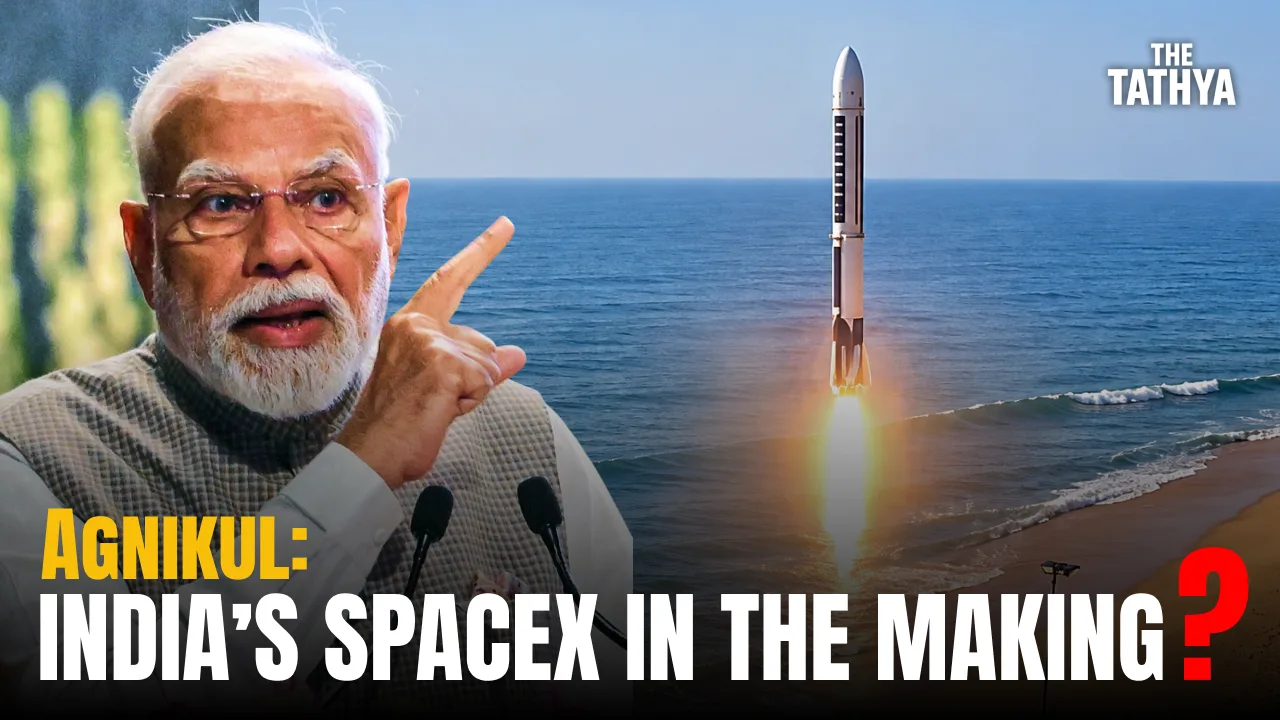
The government has committed ₹200 crore to Agnikul Cosmos for an ambitious reusable version of its Agnibaan launch vehicle. The project aims to move beyond recovering only a rocket’s first stage and develop technologies for broader system reusability, but the programme is still at the technology-development stage and has several difficult engineering milestones to clear before India has an operational reusable private rocket.
India is putting public capital behind one of the most difficult engineering problems in modern spaceflight: building a rocket that can return, recover and fly again.
On September 25, the Technology Development Board under the Department of Science and Technology signed an agreement with Chennai-based Agnikul Cosmos to provide ₹200 crore in financial support for development of the Agnibaan Reusable Launch Vehicle.
The programme is being financed through the government’s Research, Development and Innovation Fund and aims to advance Agnikul’s reusable-launch technologies from Technology Readiness Level 4 and above towards TRL 8.
The distinction matters. According to the Technology Development Board’s readiness framework, TRL 4 generally represents technology validated at the laboratory or integrated-component level, while TRL 8 represents a complete and qualified system.
Agnikul is therefore not receiving money to mass-produce an already operational reusable rocket. The ₹200 crore is intended to help move several technologies from development and demonstration towards a much more mature launch system.
There is another important detail: the support is being provided through Optionally Convertible Debentures, not as a simple ₹200 crore grant.
That makes the programme both an industrial-financing decision and a technological bet on whether an Indian private company can push reusable launch technology towards operational maturity.
What Agnikul Is Trying to Build
The government describes the project as the development of Agnibaan RLV, a reusable launch system intended to go beyond the now familiar model of recovering only the first stage of a rocket.
According to the Department of Science and Technology, the proposed architecture is being designed around full-system reusability, with technologies intended to support repeated launches while reducing launch and manufacturing costs.
The programme includes a lightweight upper stage, semi-cryogenic liquid propulsion, precise orbital insertion and propulsion systems capable of deep throttling and restart.
Those last two capabilities are particularly important for reusable rockets.
A conventional rocket engine is primarily designed to produce thrust during ascent. A reusable system may also need engines capable of restarting after shutdown, reducing thrust significantly and controlling descent with much greater precision.
Agnikul’s programme also includes a reusable upper-stage architecture and descent propulsion intended to support controlled recovery.
If successfully demonstrated, that would make the project much more ambitious than simply recovering a booster while discarding the rest of the launch vehicle.
But the language needs to be read carefully.
The government says the project seeks full-system reusability. It has not yet demonstrated an operational fully reusable rocket. Re-entry, thermal management, guidance, landing, structural durability and refurbishment are all significant engineering challenges that still have to be validated.
The ₹200 crore agreement therefore marks the beginning of a difficult development phase, not the arrival of a finished system.
Agnikul Is Not Starting From Zero
The company has already demonstrated several technologies that form the foundation of the new programme.
Agnikul’s main launch vehicle, Agnibaan, is being developed as an indigenous orbital-class rocket aimed at carrying small satellites to Low Earth Orbit.
At its core is Agnikul’s Agnilet engine, whose combustion section is manufactured as a single piece using additive manufacturing.
In May 2024, Agnikul successfully launched its Agnibaan SOrTeD technology demonstrator from its private launchpad at Sriharikota.
The flight marked several firsts for India. The government described it as the world’s first rocket flight using a single-piece 3D-printed engine, India’s first launch from a private launchpad and the country’s first launch powered by a semi-cryogenic engine.
The SOrTeD mission was suborbital rather than an orbital satellite launch. Its purpose was to test Agnikul’s indigenous propulsion and vehicle technologies and generate flight data for the larger Agnibaan programme.
That distinction is important because Agnikul has demonstrated that its propulsion architecture can fly, but it has not yet demonstrated the full chain required for reusable orbital operations.
The RDI-backed project represents a much larger technological jump.
Why Reusability Matters
Launch vehicles have historically been expensive partly because much of the rocket is discarded after a single mission.
Reusability changes that economics only if major sections of the vehicle can be recovered safely, refurbished quickly and flown repeatedly without excessive maintenance.
In theory, a successful reusable system can distribute the cost of expensive hardware across multiple launches.
That can reduce the marginal cost of each flight, allow a higher launch frequency and make it possible for operators to maintain rockets more like reusable transportation systems rather than manufacture almost entirely new vehicles for every mission.
But reuse does not automatically guarantee cheap launches.
Recovery systems add mass and complexity. Vehicles require inspection and maintenance. Hardware lifetime becomes critical, and the economics depend heavily on how many times each stage can actually be reused and how frequently the operator has customers ready to fly.
The real breakthrough therefore is not simply making a rocket land.
It is making recovery and refurbishment economical enough that the same vehicle can return to service repeatedly.
That is what makes Agnikul’s emphasis on repeatability and high-frequency launch operations strategically important.
India Is Building More Than One Reusable-Rocket Path
Agnikul’s project is also notable because India’s reusable-launch ambitions are no longer confined to ISRO.
The Department of Space has its own programmes covering booster recovery using vertical take-off and vertical landing technologies, a partially reusable Next Generation Launch Vehicle, and a winged orbital re-entry vehicle.
The Agnikul programme therefore sits alongside, rather than replaces, government-led reusable launch research.
This reflects the direction of the Indian Space Policy 2023, which explicitly allows private companies to carry out end-to-end space activities, including developing and operating launch vehicles.
ISRO’s role is gradually becoming more focused on advanced research, strategic missions and development of new technologies, while private companies are expected to provide more of the commercial scale required for India to compete internationally.
The government estimates India’s space economy at roughly $8.4 billion and has set an ambition of expanding it to around $44 billion by 2033. IN-SPACe’s long-term strategy includes a target of roughly $11 billion in exports.
Launch services are only one part of that market, but they are strategically important because satellites cannot generate revenue until they reach orbit.
A domestic private launch industry gives Indian satellite companies another option beyond government launch vehicles or purchasing rides from foreign providers.
Why the ₹200 Crore Funding Model Matters
The Agnikul agreement also shows how the government is trying to finance high-risk technology differently.
The broader Research, Development and Innovation Fund has a corpus of ₹1 lakh crore and is intended to support private-sector research in areas where technology development is expensive, risky and difficult to finance through ordinary commercial lending.
The RDI scheme was approved in July 2025 and formally launched in November that year. The Technology Development Board is one of the institutions responsible for deploying funding into eligible technology companies.
By July 2026, TDB had approved 22 projects with a combined project cost of ₹4,744 crore and RDI support of ₹2,192 crore.
Reusable launch vehicles fit the logic of such a programme particularly well.
The potential commercial payoff is large, but the engineering risk is equally high. A company may need to spend years developing engines, structures, control systems and recovery technologies before generating regular launch revenue.
Traditional debt is poorly suited to that development cycle.
Government-backed long-term capital can therefore help companies bridge the gap between a laboratory technology and a commercially deployable system.
The risk, of course, is that not every supported project will succeed.
That is inherent to deep-technology financing. The relevant measure should not be whether every funded company produces a commercially successful system, but whether the financing mechanism creates strategically valuable technologies and commercially viable firms that would otherwise struggle to attract sufficiently patient capital.
The Bigger Challenge Is Launch Economics
Agnikul ultimately has to compete in a global launch market that is becoming more demanding.
Customers increasingly expect flexible launch schedules, reliable orbital insertion and competitive pricing. At the same time, the growth of small satellites and satellite constellations is creating demand for dedicated and responsive launch options.
Agnikul’s basic proposition is built around this market.
Agnibaan is designed as a configurable small-satellite launcher, with the company positioning it as an on-demand vehicle that can be adapted for different payload requirements.
Reusability could make that model more competitive if Agnikul can reduce the hardware cost per mission and increase flight frequency.
But this remains conditional.
The company first has to mature its orbital launch vehicle, prove dependable access to orbit, develop the reusable architecture, demonstrate recovery and then show that recovered hardware can be flown again economically.
That is a long sequence of technological milestones.
The government's TRL target reflects this reality. Moving towards TRL 8 means producing a complete and qualified system, not simply demonstrating individual components.
Space Debris Is Another Part of the Equation
The government also says full-system reusability could help limit the generation of space debris.
There is logic behind that claim, but it requires qualification.
Rocket stages and mission-related objects can contribute to the population of objects left in orbit. Designing upper stages around controlled recovery rather than abandonment could reduce some mission-related debris.
However, launch-vehicle reusability alone cannot solve the wider space-debris problem.
Most long-term orbital congestion comes from a combination of inactive satellites, fragmentation events, spent stages and increasing numbers of spacecraft. Responsible spacecraft disposal, collision avoidance and space-traffic management remain necessary regardless of how reusable launch vehicles become.
For Agnikul, the more immediate advantage of upper-stage recovery would be economic and operational if the hardware can actually be reused.
The environmental benefit would be an additional consequence.
What This Could Mean for India
The strategic significance of the programme is broader than one startup.
India already possesses sovereign launch capability through ISRO. The next challenge is creating a commercial launch industry that can scale beyond government missions and compete for global customers.
That requires private companies capable not only of designing rockets, but of launching frequently, lowering costs, attracting satellite customers and manufacturing at scale.
Agnikul is part of a wider private launch ecosystem that now includes companies such as Skyroot and a growing network of propulsion, satellite and space-technology startups.
Government data show around 440 space-technology startups were registered in India by August 2026. IN-SPACe had issued 113 authorisations to 52 non-government entities by that point.
The strategic opportunity is therefore not simply for India to possess reusable-rocket technology.
It is to develop an industrial ecosystem in which propulsion, additive manufacturing, electronics, launch infrastructure and satellite companies reinforce each other.
A successful reusable launcher could make frequent Indian commercial launches more viable. Failure would still generate engineering experience that could feed into future systems, provided the underlying technology and intellectual property remain within the domestic ecosystem.
That is why the ₹200 crore agreement should not be viewed merely as government funding for another rocket.
It is an attempt to push an Indian private launch company across one of the hardest gaps in deep technology: from demonstrating individual innovations to qualifying an integrated system that can potentially operate repeatedly.
Whether Agnibaan RLV ultimately becomes that system remains unresolved.
The next milestones will matter more than the funding announcement itself: orbital launch capability, reusable propulsion tests, controlled descent, recovery and eventually the ability to demonstrate that recovered hardware can actually fly again.
If Agnikul clears those steps, India would gain more than another launch vehicle.
It would gain a private-sector pathway towards reusable access to orbit, one of the technologies likely to shape the economics of commercial spaceflight over the coming decades.
Sources
Press Information Bureau, Ministry of Science & Technology - September 25 agreement between TDB and Agnikul Cosmos; ₹200 crore RDI support, Optionally Convertible Debentures, Agnibaan RLV, TRL target, propulsion architecture and full-system reusability objective. https://www.pib.gov.in/PressReleasePage.aspx?PRID=2314836&lang=2®=48&utm_source=chatgpt.com
Technology Development Board - National Technology Readiness Assessment Framework; supports the meaning of TRL 4 and the progression towards a complete and qualified system at TRL 8. https://tdb.gov.in/sites/default/files/2026-01/nationaltechnologyreadinessassessmentframework_final.pdf?utm_source=chatgpt.com
Press Information Bureau, Department of Space - official account of Agnikul’s May 2024 Agnibaan SOrTeD flight, including the single-piece 3D-printed engine, private launchpad and semi-cryogenic propulsion milestones. https://www.pib.gov.in/PressReleasePage.aspx?PRID=2022161&lang=2®=3&utm_source=chatgpt.com
Agnikul Cosmos - official technical overview of Agnibaan, Agnilet and the company’s configurable small-satellite launch architecture. https://www.agnikul.in/product/?utm_source=chatgpt.com
ISRO, Government of India - Indian Space Policy 2023; supports the policy framework enabling private entities to undertake end-to-end space activities and the changing role of industry within India’s space ecosystem. https://www.isro.gov.in/media_isro/pdf/IndianSpacePolicy2023.pdf?utm_source=chatgpt.com
Press Information Bureau, Ministry of Science & Technology - RDI Fund structure, ₹1 lakh crore corpus, TDB’s role as a second-level fund manager and project approvals under the scheme. https://www.pib.gov.in/PressReleasePage.aspx?PRID=2288307&lang=1®=48&utm_source=chatgpt.com
Press Information Bureau, Department of Space - August 2026 data on India’s private space ecosystem, including around 440 registered space-technology startups and IN-SPACe authorisations. https://www.pib.gov.in/PressReleasePage.aspx?PRID=2298799&lang=1®=48&utm_source=chatgpt.com
IN-SPACe - Decadal Vision and Strategy for the Indian Space Economy; supports the target of expanding the sector to $44 billion by 2033 and building a larger commercial launch and export ecosystem. https://www.inspace.gov.in/sys_attachment.do?sys_id=f461d9698775f1104efb31d60cbb35df&utm_source=chatgpt.com