
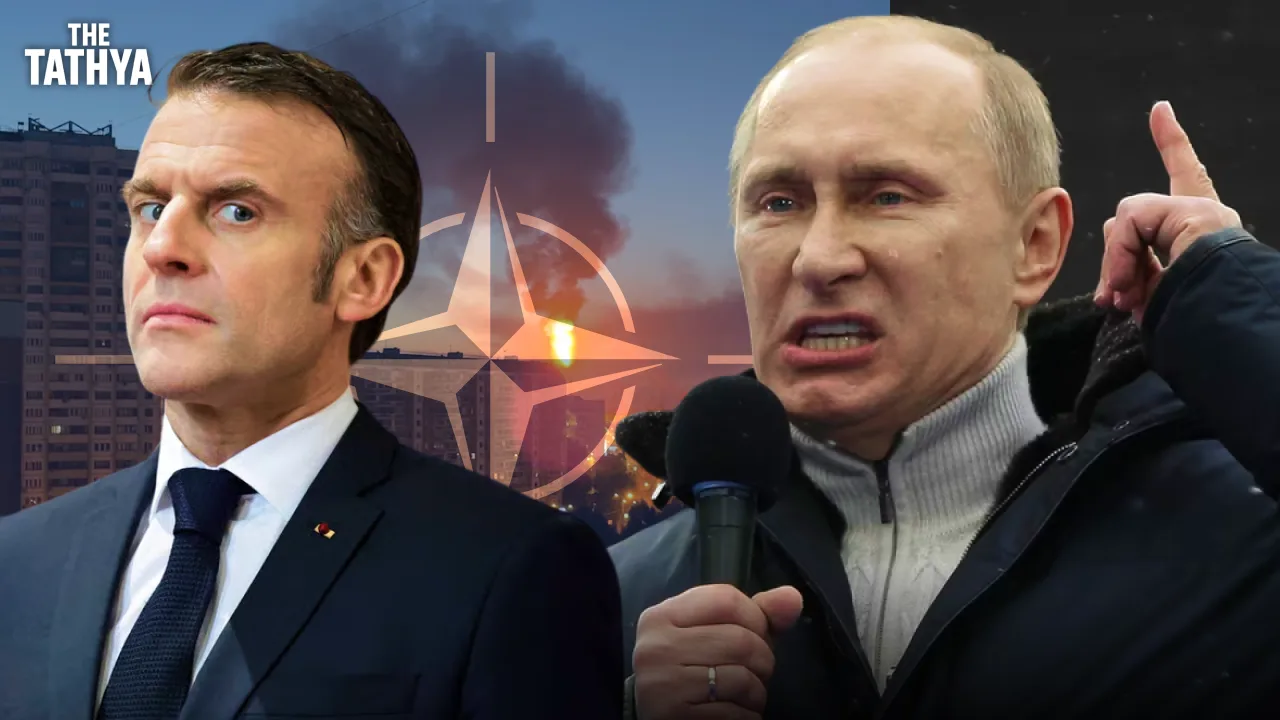
Poland says intelligence assessments point to possible Russian drone and missile provocations against NATO countries supporting Ukraine, while even neutral Switzerland is strengthening its preparations for long-range and hybrid threats. Europe is not saying a wider war with Russia is inevitable, but the threshold for what governments now consider worth preparing for has changed sharply. For India, that matters because a deeper Russia-Europe confrontation could affect energy supplies, defence support, trade with Europe and New Delhi’s ability to maintain close relations with both sides.
Europe is increasingly preparing for security scenarios that would have appeared remote only a few years ago.
On September 17, Polish Prime Minister Donald Tusk told parliament that intelligence available to Poland and its allies pointed to a risk of Russian drone or missile strikes against countries supporting Ukraine, including Poland. Tusk said such attacks could be presented as “accidental” in an attempt to weaken NATO’s willingness to respond collectively.
The statement came from the Polish prime minister citing intelligence assessments. It is not public proof that Russia has made a decision to attack NATO, and the underlying intelligence has not been released. NATO itself says there is currently no imminent military threat to the alliance’s security.
That distinction is central to understanding what is happening in Europe.
The important development is not that a Russian attack on NATO has become inevitable. It is that European governments are increasingly spending political and military resources preparing for scenarios in which the war in Ukraine spills beyond Ukraine’s borders, either deliberately or through operations designed to remain below the threshold of an obvious conventional attack.
Switzerland Shows How Far the Security Debate Has Shifted
The clearest example may not be Poland, which borders Ukraine and has long viewed Russia as a major security threat.
It is Switzerland.
On September 18, the Swiss Federal Council formally adopted its Security Policy Strategy 2026, describing an international environment that has become substantially more unstable since Russia’s invasion of Ukraine.
The strategy identifies hybrid warfare, cyberattacks, espionage, sabotage, economic dependencies and military threats as increasingly interconnected security challenges. Switzerland plans to strengthen national resilience, civilian protection and its ability to defend itself.
Crucially, Bern does not assess a direct armed attack on Switzerland as likely in the foreseeable future.
But the government also says that this does not remove Switzerland from the reach of a wider European conflict. Long-range drones and ballistic missiles could threaten Swiss territory even without a conventional ground invasion. Switzerland therefore wants greater capability to defend against long-range attacks while improving cooperation with other countries if a crisis exceeds what it can manage alone.
That is a meaningful shift.
Swiss neutrality has historically reduced the country’s exposure to military confrontation between European blocs. Modern warfare changes that calculation because neutrality cannot prevent a missile from crossing airspace, protect a power grid from cyberattack or guarantee that critical infrastructure will remain outside a hybrid conflict.
When even Switzerland begins planning more seriously for these scenarios, it shows how deeply Russia’s war against Ukraine has altered European security thinking.
The Battlefield Is Moving Far Beyond the Front Line
The military technology being used in the Russia-Ukraine war helps explain this change.
On September 20, Russian authorities reported the largest Ukrainian drone assault on Moscow since the beginning of the war.
Moscow Mayor Sergei Sobyanin said around 450 drones were directed towards Moscow, as part of a much larger series of attacks in which Russian authorities said more than 1,600 drones had been intercepted since Saturday. Some penetrated Russian defences, with Moscow’s oil refinery damaged and residential areas struck. Authorities reported three deaths in the Moscow region.
Those figures are based substantially on Russian official accounts and cannot all be independently verified. The careful conclusion is therefore not that every interception figure has been independently established, but that Ukraine demonstrated the capacity to mount an exceptionally large long-range drone operation against Russia’s capital region.
Russia has meanwhile continued using missiles and drones against targets across Ukraine, including western areas close to NATO territory. On September 17, Poland scrambled fighter aircraft as Russian strikes hit western Ukraine near the Polish border, though Warsaw reported no violation of Polish airspace during that episode.
The significance is technological as much as geographical.
Both sides can now conduct large-scale strikes hundreds of kilometres from the conventional battlefield. That makes the old distinction between a protected rear area and a frontline increasingly difficult to maintain.
For European governments, the concern is therefore not limited to Russian troops crossing a NATO border. It also includes drones, missiles, cyber operations and sabotage that may be harder to classify immediately as either an accident, a hybrid operation or an armed attack.
Why This Matters for India
India is geographically distant from the European battlefield, but it is economically and strategically connected to both sides of the emerging divide.
Russia remains important to India in two areas in particular: energy and defence.
Russian crude accounted for a record 50.83% of India’s oil imports in July 2026, or around 2.47 million barrels per day, according to trade data reported by Reuters. Russian supplies became particularly important as disruptions in the Middle East increased pressure on alternative sources.
India’s overall dependence on imported crude means any major disruption to international oil flows can quickly become a domestic economic issue. PPAC, under the Ministry of Petroleum and Natural Gas, continues to track India’s substantial crude import requirements as part of its official petroleum data.
A direct confrontation between Russia and NATO could therefore affect India even without involving Indian territory.
Further sanctions on Russian energy, restrictions on shipping or insurance, disruptions to payment mechanisms, or difficulties moving Russian crude could increase costs for Indian refiners. If alternative supplies were also constrained, the consequences could extend to India’s import bill, inflation and the rupee.
This does not mean such effects are certain. They would depend on the scale of any escalation and on the sanctions response adopted by the United States and Europe. But India’s present level of exposure to Russian oil makes European security developments economically relevant to New Delhi.
Defence Creates a Different Kind of Exposure
Russia also remains embedded in India’s defence ecosystem.
The relationship is no longer limited to India purchasing complete weapons platforms from Moscow. An official India-Russia statement issued in December 2025 said the partnership was being reoriented towards joint research, development, co-production and the manufacture in India of spare parts and components needed to maintain Russian-origin equipment used by the Indian Armed Forces.
That matters because a prolonged Russian confrontation with Europe could put further pressure on Russia’s defence-industrial capacity.
The issue for India is not simply whether it wants to purchase additional Russian weapons. Existing Russian-origin aircraft, armoured vehicles, air-defence systems and other equipment require components, maintenance and upgrades throughout their service lives.
If Russia is forced to prioritise its own military requirements for an extended period, India has an additional reason to accelerate domestic production of spares, maintenance capability and substitutes.
In that sense, the European security crisis strengthens an argument India was already making: defence supply chains become a strategic vulnerability when they depend too heavily on any single foreign country.
Europe Is Becoming More Important to India at the Same Time
The situation is complicated by another trend. India is not moving away from Europe. Its economic and security relationship with Europe is becoming deeper.
India and the European Union concluded negotiations on a Free Trade Agreement on January 27, 2026. EU-India trade in goods reached €118 billion in 2025, making the EU India’s third-largest trading partner. The agreement has been concluded but has not yet entered into force.
India and the EU also announced a Security and Defence Partnership during the January summit. India’s Ministry of Defence has since sought greater cooperation between Indian and European defence industries, including co-development and co-production.
The trend has continued through individual European partnerships.
India and Germany signed a Defence Industrial Cooperation Roadmap in April, with discussions covering co-development and co-production in advanced defence technologies. In September, India and Belgium also called for deeper defence-industrial collaboration.
This creates both a challenge and an opportunity for India.
A sharper Russia-Europe confrontation would place two important Indian relationships under greater strain. New Delhi would have reasons to preserve Russian energy and defence links while also protecting expanding trade, technology and security relationships with Europe.
At the same time, Europe’s rearmament creates potential openings for Indian defence manufacturers.
European states are increasing investment in ammunition, drones, air defence and other military capabilities. India has already been proposing co-production arrangements with European countries. Germany and India, for example, have specifically discussed cooperation in areas including advanced sensors, unmanned systems and other niche technologies.
There is no guarantee that European rearmament will translate into major orders for Indian companies. European governments will naturally prioritise their own industries in many areas. But a larger European defence market, combined with India’s effort to expand domestic manufacturing and defence exports, creates opportunities that did not exist at the same scale before the Ukraine war.
The Larger Strategic Problem for India
The more serious challenge would emerge if Europe’s current preparations developed into a prolonged direct confrontation between Russia and NATO.
India has maintained significant relations with both Russia and Western powers by avoiding treaty-bloc politics and deciding partnerships issue by issue. That approach provides New Delhi with substantial diplomatic flexibility.
A Russia-NATO confrontation would narrow that space.
Western governments could increase pressure on countries maintaining major economic links with Moscow. Russia could become still more dependent on China economically and strategically. Energy markets could become more fragmented, while defence supply chains could face additional sanctions and export controls.
For India, none of those outcomes would be particularly comfortable.
A Russia that remains capable of maintaining an independent relationship with India gives New Delhi more room in Eurasia. A commercially important Europe provides technology, investment and export markets. India has strategic reasons to preserve both relationships rather than see them become mutually exclusive.
That is why European preparations matter even if the war never expands into NATO territory.
The Tathya Analysis
There is currently no publicly established evidence that Russia is preparing an imminent conventional attack on NATO.
Poland’s warning is based on intelligence assessments about possible hybrid drone and missile operations, while NATO itself says there is no imminent military threat to the alliance. Switzerland likewise considers a direct armed attack unlikely.
The more consequential development is therefore the change in European planning.
Poland is preparing for deliberately ambiguous strikes. NATO has undertaken what it describes as its largest reinforcement of collective defence in a generation. Switzerland is strengthening protection against long-range attacks despite its neutrality. European governments are increasingly treating drones, cyberattacks, sabotage and missile threats as part of a connected security environment rather than separate problems.
For India, the question is not whether to accept either a Russian or Western narrative of the conflict.
The practical question is what happens to Indian interests if the Russia-Europe divide hardens further.
The first risk is energy. India has become heavily exposed to Russian crude, making any future restrictions on Russian oil, shipping, insurance or payments relevant to Indian economic stability.
The second is defence. A Russia focused increasingly on its own wartime requirements strengthens the case for India to localise maintenance and production for Russian-origin systems while continuing to diversify suppliers.
The third is diplomatic. India’s expanding relationships with Europe and its longstanding partnership with Russia are both valuable. A direct confrontation between the two would make maintaining those relationships simultaneously more difficult.
But there is also an opportunity. European rearmament is creating demand for new suppliers, technologies and production capacity at the same time that India is seeking a larger role in global defence manufacturing.
The central development to watch is therefore not whether Europe has correctly predicted a Russian attack.
It is whether preparations for that possibility become a permanent feature of European security policy.
If they do, Europe’s relationship with Russia may remain structurally confrontational even if the fighting in Ukraine eventually declines.
For India, that would have consequences extending from oil tankers and defence supply chains to trade agreements and foreign policy.
Europe may be preparing for a war that never comes. But the geopolitical restructuring produced by that preparation is already underway.
Sources
- Press Information Bureau, Government of India, India-Russia Military and Military-Technical Cooperation. Supports the article’s discussion of joint research, co-development, co-production and manufacturing in India of spares for Russian-origin equipment. PIB: India-Russia Military and Military-Technical Cooperation
- Press Information Bureau, Government of India, Outcomes of the India-EU Summit, January 2026. Supports the conclusion of India-EU FTA negotiations and the Security and Defence Partnership. PIB: India-EU Summit Outcomes
- Press Information Bureau, Ministry of Defence, India-Germany Defence Industrial Cooperation Roadmap. Supports the analysis of growing India-Europe defence-industrial cooperation. PIB: India-Germany Defence Cooperation
- Petroleum Planning & Analysis Cell, Government of India, Import/Export of Crude Oil and Petroleum Products. Provides the Indian official data framework for the country’s crude-import dependence. PPAC: India Petroleum Import and Export Data
- Swiss State Secretariat for Security Policy, Security Policy Strategy of Switzerland 2026. Primary source for Switzerland’s assessment of its deteriorating security environment, hybrid threats and long-range missile and drone risks. Swiss Government: Security Policy Strategy 2026
- NATO, NATO’s Support for Ukraine. Supports NATO’s statement that there is currently no imminent military threat to the alliance and documents the reinforcement of NATO’s collective defence. NATO: Support for Ukraine and Alliance Defence
- European Commission, EU Trade Relations with India. Supports the €118 billion 2025 goods-trade figure, the EU’s position as India’s third-largest trading partner and the status of FTA negotiations. European Commission: EU Trade Relations with India
- Reuters, Three dead in Moscow region, drones hit oil refinery in Russian capital, September 20, 2026. Supports the reported scale of the Moscow drone assault, refinery damage and Russian-reported casualties. Reuters: Moscow Drone Attack and Refinery Damage
- Reuters, Russian share of India’s oil imports surges to record high in July, August 14, 2026. Supports the reported 50.83% Russian share of Indian crude imports and the 2.47 million barrels-per-day figure. Reuters: Russian Share of India’s Oil Imports