
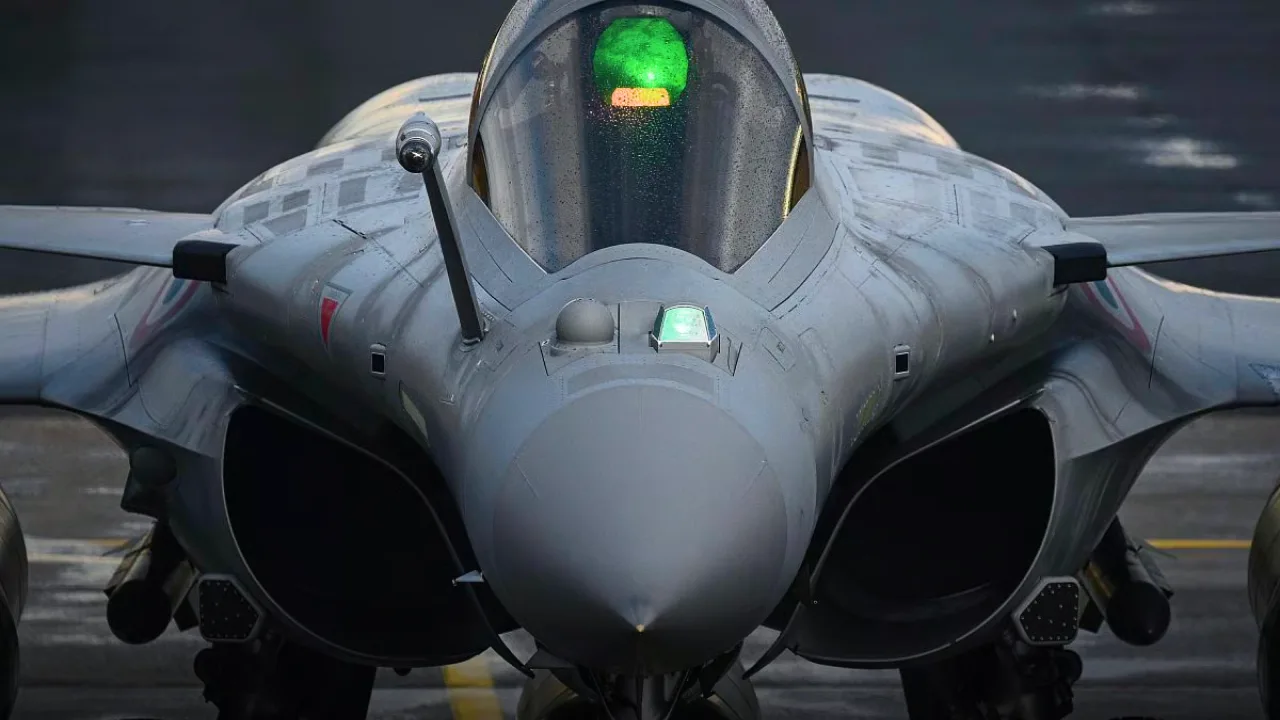
India’s proposed acquisition of 114 Rafale fighters has entered formal bid evaluation, with Defence Secretary Rajesh Kumar Singh saying the procurement cycle could reach a conclusion by the end of the current financial year. Unlike India’s earlier Rafale purchases, the programme is being structured around domestic assembly, significant indigenisation and integration of Indian weapons, making the industrial terms almost as important as the aircraft themselves.
India’s planned acquisition of 114 additional Rafale fighters is moving from political approval towards the harder questions of price, production and technology integration.
Defence Secretary Rajesh Kumar Singh said on October 1 that bids submitted for the programme are under formal evaluation and that the Ministry of Defence should be able to “reach some conclusion” in the procurement cycle by the end of the current financial year.
That wording is important.
India has not yet signed a contract for 114 aircraft. Singh has set an expectation for progress towards a procurement conclusion by FY2026-27 end, but evaluation, negotiations and final financial approval still remain part of the acquisition process.
What is already clearer is the industrial model India wants.
Singh said the acquisition would proceed as a Buy and Make programme, with the bulk of the aircraft assembled in India, significant levels of indigenisation and integration of Indian weapons and systems.
That potentially makes the 114-aircraft programme fundamentally different from India’s first Rafale purchase.
The Programme Has Already Crossed Its First Formal Approval
The Defence Acquisition Council granted Acceptance of Necessity for the Indian Air Force’s Multi Role Fighter Aircraft programme, specifically identifying Rafale, on February 12, 2026.
The Ministry of Defence said at the time that the majority of the aircraft would be manufactured in India. The Rafale approval formed part of a much larger group of capital acquisition proposals valued at approximately ₹3.60 lakh crore.
Acceptance of Necessity is not a procurement contract.
Under India’s defence acquisition process, it is followed by stages including solicitation and evaluation of offers, technical assessment, negotiations, financial approvals and finally the award of a contract.
The Defence Secretary’s latest statement indicates that the programme is now deeper into this process, with submitted bids being evaluated.
Several reports place the potential value of the 114-aircraft acquisition at around ₹3.25 lakh crore, which would make it one of India’s largest defence procurements. That remains a reported estimate rather than a final contract value because commercial evaluation and negotiations have not been completed.
This Is Not the Same Rafale Deal India Signed in 2016
India already operates 36 Rafales with the Indian Air Force, acquired from France through the 2016 inter-governmental agreement.
Those aircraft were delivered from France.
The Navy followed with a separate agreement in April 2025 for 26 Rafale Marine aircraft, comprising 22 single-seat and four twin-seat fighters. That contract was valued at around ₹63,000 crore and includes training, simulators, weapons and performance-based logistics.
The naval agreement also introduced an important industrial component.
The Ministry of Defence said it includes technology transfer for the integration of indigenous weapons in India, creation of a Rafale fuselage production facility and maintenance, repair and overhaul facilities for aircraft engines, sensors and weapons.
The proposed 114-aircraft programme goes further.
According to Singh, most of the aircraft would be assembled in India rather than simply imported as completed fighters.
If the final contract retains that structure, India would move from operating Rafales and supporting selected Rafale manufacturing activities to hosting a substantial fighter-production programme.
Indian Weapons Integration Could Be More Important Than Assembly
Domestic assembly will attract most of the attention because fighter production creates factories, jobs and supply chains.
But integration of Indian weapons may have greater long-term strategic value.
A fighter aircraft remains dependent on its weapons ecosystem throughout its service life. If every new air-to-air missile, precision weapon or stand-off weapon requires the customer to return to the foreign manufacturer for integration, operational sovereignty remains limited even if parts of the aircraft were assembled domestically.
Singh said the French side has agreed to integrate Indian weapons not only on the proposed 114 aircraft but also under the already-contracted Rafale Marine programme.
The 2025 naval agreement independently confirms that technology transfer for indigenous weapon integration forms part of that programme.
The specific Indian weapons intended for the 114 fighters have not yet been officially listed.
Potential integration possibilities are therefore separate from confirmed integration commitments.
India has several indigenous weapon programmes that could eventually become relevant to the Rafale ecosystem, but until the final configuration is disclosed, individual missile names should not be treated as confirmed.
What matters now is the principle: India wants the ability to combine a French combat aircraft with a growing Indian weapons ecosystem.
Weapon Integration Is Not the Same as Full Technology Sovereignty
There is also a limit to what can currently be inferred.
Public statements confirm indigenous weapons integration, domestic assembly and significant indigenisation.
They do not establish that India will receive the complete Rafale source code, unrestricted access to all mission-system software or ownership of the fighter’s intellectual property.
Those are very different levels of technological control.
A country can receive the technical interfaces necessary to integrate approved weapons without receiving unrestricted control over every software layer in an aircraft.
The final agreement will therefore need to be judged by the depth of access India receives.
If Indian engineers can independently integrate weapons, maintain key systems, manufacture significant assemblies and progressively localise parts, the programme would create substantially more strategic value than a conventional import.
If localisation remains concentrated mainly in final assembly while critical avionics, engines, sensors and software remain dependent on France, the industrial benefits would be more limited.
The phrase “Made in India” alone will not answer that question.
The composition of the Indian content will.
A Second Fighter-Manufacturing Ecosystem
Singh has described the Rafale programme as a way to create another major fighter-production line in India.
At the NDTV Defence Summit on September 27, he said France had accepted India’s requirement for manufacturing in India with significant indigenisation and argued that the programme would help establish a second fighter-production line in the country.
That statement should not be interpreted literally as India currently possessing only one physical fighter assembly line.
HAL already operates multiple production lines for the Tejas programme, including facilities in Bengaluru and Nashik, while private manufacturers are increasingly producing major structural assemblies.
The more important interpretation is industrial.
For decades, HAL has been the central institution around which Indian fighter manufacturing has been organised.
A large Rafale production programme could create another industrial network involving a foreign original equipment manufacturer, Indian private companies, component suppliers, maintenance companies and aerospace MSMEs.
That diversification matters.
A fighter-manufacturing ecosystem requires far more than final assembly. It needs precision machining, composites, avionics, wiring, hydraulics, landing gear, electronic systems, tooling, testing, maintenance and a large skilled workforce.
A 114-aircraft production run would be large enough to justify investments that a much smaller order might not support.
But India Should Measure Indigenisation by Depth, Not Percentage Alone
A headline indigenous-content percentage can be misleading.
Not all aircraft components have the same strategic value.
Locally manufacturing structural sections is industrially useful. Manufacturing mission computers, electronic warfare systems, sensors or propulsion technologies can create much deeper technological capability.
The engine remains particularly important.
The Rafale is powered by Safran’s M88 turbofan. The Rafale Marine agreement provides for an Indian MRO ecosystem for engines, but that is different from India independently designing and manufacturing the engine itself.
India continues to pursue indigenous military aero-engine capability separately.
The same distinction applies across the fighter.
The strongest industrial outcome from the 114-aircraft programme would therefore combine three things: substantial Indian manufacturing, meaningful participation by Indian companies in high-value systems and enough technical autonomy to integrate and support Indian weapons throughout the fleet’s operational life.
That would create capabilities that survive even after the final Rafale leaves the production line.
Why the IAF Needs Aircraft Before Indigenous Programmes Mature
The procurement is being advanced against a long-running fighter-strength problem.
The Indian Air Force has operated below its authorised 42 fighter squadrons for years while older aircraft have progressively retired.
That creates a timing problem.
India is simultaneously developing several indigenous fighter programmes, but they operate on different schedules.
The Tejas Mk1A is already under production. India has placed two major orders with HAL: 83 aircraft approved in 2021 and another 97 contracted in September 2025.
The second order alone is worth more than ₹62,370 crore and is scheduled for deliveries beginning in 2027-28. Those aircraft are expected to contain more than 64% indigenous content and incorporate systems including the indigenous Uttam AESA radar.
The LCA Mk2 is the next indigenous step.
Singh said this week that its first flight is planned for around the middle of 2027, after which prototypes will have to undergo evaluation before the Air Force can move towards large-scale procurement.
The Advanced Medium Combat Aircraft sits further ahead.
The government has opened its execution model to competition between Indian public and private-sector entities, with the programme designed to create a domestic fifth-generation fighter capability.
The Defence Secretary has said India is presently prioritising AMCA rather than committing to a foreign fifth-generation fighter programme.
The problem is that none of these programmes can instantly replace retiring squadrons.
That creates the operational case for Rafale.
Rafale and Tejas Are Not Necessarily Competing Programmes
A common concern is that a very large Rafale order could weaken India’s indigenous fighter programmes by diverting budgets, manpower or political attention.
The government’s position is that the programmes serve different requirements.
Singh said at the NDTV Defence Summit that the Rafale procurement would continue alongside Tejas Mk1A rather than impede it. He described the indigenous programme as one that should develop progressively through new Indian radars, weapons and other systems.
The numbers support the idea that India is pursuing parallel pathways.
HAL already has major contracted Mk1A production work extending into the next decade. LCA Mk2 development continues separately, while AMCA is being structured as a major indigenous development programme.
Rafale would therefore address a more immediate medium-term requirement while the domestic platforms mature.
But avoiding competition on paper is easier than avoiding it financially.
A 114-aircraft Rafale acquisition could consume an enormous share of capital procurement expenditure over many years.
Programme sequencing, payment schedules and domestic content will therefore determine whether India can fund imported technology while simultaneously sustaining Tejas, LCA Mk2, AMCA, unmanned aircraft and indigenous engine development.
Commonality Gives Rafale Another Advantage
India already operates the Rafale with the Air Force and has ordered Rafale Marine for the Navy.
That creates an advantage compared with introducing an entirely new fighter type.
Pilots, ground crews, training establishments, maintenance systems and parts of the weapons and logistics ecosystem already exist.
The naval agreement itself emphasises commonality between Rafale Marine and the Air Force fleet, saying it will optimise training and logistics across both services.
Adding another 114 aircraft would take that commonality much further.
A larger fleet can spread training, maintenance and support costs across more aircraft. It can also justify deeper localisation because the production volume becomes large enough to support domestic facilities.
This is one reason the industrial structure of the new programme matters so much.
India is no longer negotiating around a fleet of only 36 Air Force fighters.
The combined Rafale ecosystem could eventually include the existing 36 IAF aircraft, 26 naval aircraft and the proposed 114 additional fighters.
That scale changes the economics of localisation.
The Real Question Is What India Retains After Aircraft 114
The immediate military case for additional fighters is clear enough: the Air Force needs combat aircraft faster than its future indigenous programmes can currently deliver them.
But a programme of this size should be judged on a longer timeline.
India could spend hundreds of thousands of crores and emerge with an extremely capable fleet while remaining dependent on an overseas supplier for core upgrades, specialised maintenance and future weapon integration.
Or it could use the order to create manufacturing capability, engineering knowledge, weapon-integration autonomy, domestic maintenance capacity and a supply chain that later feeds indigenous programmes.
Those outcomes are not the same.
The 2025 Rafale Marine agreement already shows movement towards the second model through indigenous weapon integration, fuselage manufacturing and MRO facilities.
The 114-aircraft programme gives India much greater negotiating leverage because of its scale.
The challenge will be converting that leverage into capabilities that remain in India after the procurement itself is complete.
What to Watch Before the Deal Is Signed
The next milestone is the conclusion of bid evaluation and movement into final negotiations.
Several questions will determine the strategic value of the package.
How many aircraft will arrive directly from France, and how many will be assembled in India?
What percentage of the programme’s value will actually remain in the Indian economy?
Which structures, electronics and systems will be manufactured domestically?
Which Indian weapons will be integrated?
What level of technical documentation will Indian entities receive for future weapon integration?
How much MRO work can be performed independently in India?
And which Indian company or industrial consortium will anchor the production ecosystem?
Until those details are finalised, the programme should not be reduced to either of two simplistic narratives: that India is merely importing another foreign fighter, or that domestic assembly automatically makes the Rafale an indigenous aircraft.
Neither description captures what is being negotiated.
The proposed deal sits between those two extremes.
India is buying a foreign-designed fighter to address an urgent operational requirement, but it is trying to use the scale of that purchase to acquire a deeper domestic industrial capability at the same time.
The most consequential number may therefore not be 114.
It may be how much of the knowledge, production, weapons ecosystem and lifecycle support behind those aircraft India ultimately controls.
If the programme achieves that, Rafale could do more than restore squadron numbers.
It could help build an aerospace industrial base that continues producing value long after the final aircraft is delivered.
Sources
Ministry of Defence, Government of India: Defence Acquisition Council approval of Acceptance of Necessity for the Multi Role Fighter Aircraft (Rafale) programme on February 12, 2026; confirms that the majority of the aircraft are intended to be manufactured in India. https://www.pib.gov.in/PressReleasePage.aspx?PRID=2227018&lang=1®=1
ANI via WebIndia123: Defence Secretary Rajesh Kumar Singh’s October 1, 2026 statement that submitted bids are under evaluation, the programme is being pursued under a Buy and Make model, most aircraft would be assembled in India and Indian weapons and systems would be integrated. https://news.webindia123.com/news/Articles/India/20261001/4505973.html
NDTV Defence Summit 2026: Defence Secretary’s statement that India wants significant Rafale indigenisation and that the procurement could create another major fighter-production ecosystem while the Tejas programme continues. https://www.ndtv.com/india-news/ndtv-defence-summit-2026-live-updates-key-announcements-defence-strategy-and-military-technology-rajnath-singh-keynote-address-12103640
NDTV: reporting on the proposed 114-aircraft programme, the approximately ₹3.25 lakh crore reported valuation, Dassault’s formal proposal and the government’s domestic-production objectives. https://www.ndtv.com/india-news/exclusive-defence-secretary-defends-34-billion-114-rafale-deal-says-tejas-on-track-12108990/amp/1
Ministry of Defence, Government of India: April 2025 inter-governmental agreement for 26 Rafale Marine aircraft; confirms indigenous weapons-integration technology transfer, a Rafale fuselage production facility and Indian MRO facilities for engines, sensors and weapons. https://www.pib.gov.in/PressReleasePage.aspx?PRID=2124851&lang=1®=3
Ministry of Defence, Government of India: September 2025 contract for 97 additional LCA Mk1A aircraft; supports the scale, delivery schedule and more than 64% indigenous content of the second Mk1A order. https://www.pib.gov.in/newsite/erelcontent.aspx?lang=2®=48&relid=276527
Ministry of Defence, Government of India: AMCA Execution Model, confirming competitive participation by Indian public and private-sector entities in development of the indigenous fifth-generation fighter. https://www.pib.gov.in/PressReleasePage.aspx?PRID=2210154&lang=1®=3
Times of India: Defence Secretary’s October 2026 comments that the 114-aircraft procurement could reach a conclusion by the end of the financial year and that the French side has agreed to Indian weapons integration. https://timesofindia.indiatimes.com/defence/news/114-rafale-deal-likely-by-fy-end-french-firm-agrees-to-integrate-indian-weapons-def-secy/articleshow/134626952.cms