
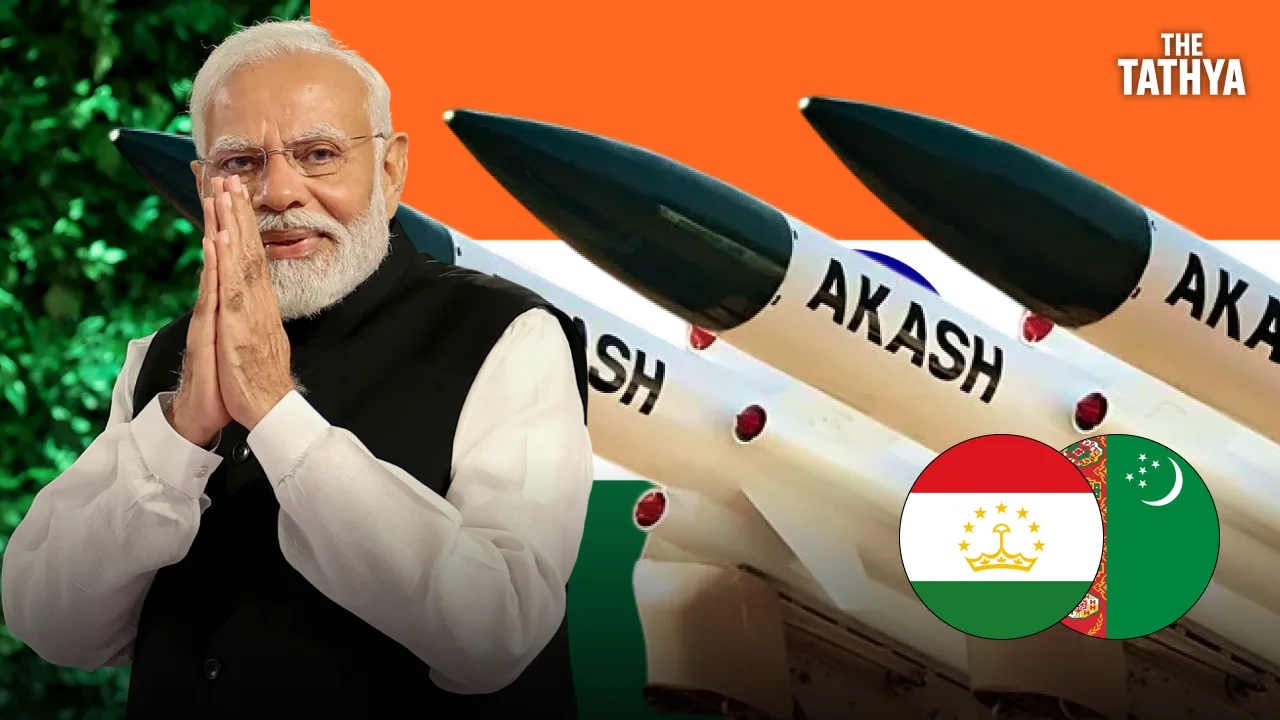
India’s indigenous Akash air-defence system has moved beyond its first overseas customer, Armenia, with Defence Secretary Rajesh Kumar Singh confirming exports to Tajikistan and Turkmenistan. The expansion gives India a new defence foothold in Central Asia and comes after the government publicly highlighted Akash’s deployment during Operation Sindoor, although contract values, quantities and recipient-country details remain largely undisclosed.
India’s Akash air-defence system has acquired two new export customers in a region long supplied predominantly by Russian and Soviet-origin military equipment.
Defence Secretary Rajesh Kumar Singh said on October 1 that India had exported Akash systems to Tajikistan and Turkmenistan, following earlier deliveries to Armenia.
“The first customer was Armenia, which has taken multiple batteries. Thereafter, we’ve also exported it to Tajikistan and Turkmenistan,” Singh told ANI. He added that Akash production had stabilised and that India continued to place additional orders for its own armed forces.
The confirmation is important because it moves Akash beyond a single foreign customer and into Central Asia, where India has been trying to deepen defence and security engagement.
But several details remain unavailable publicly.
Neither the Indian government nor the governments of Tajikistan and Turkmenistan have disclosed contract values, quantities, configurations or delivery schedules. A regional analysis published shortly before Singh’s statement noted that recipient governments had not publicly confirmed the reported deliveries.
The strategic story is therefore clearer than the commercial one: Akash now has three confirmed overseas customers according to India’s Defence Secretary, but the scale of the Central Asian sales remains undisclosed.
From Export Approval to Three Overseas Customers
Akash was not originally developed as an export product.
The system was designed by DRDO to provide mobile air defence for the Indian Army and Indian Air Force. It entered IAF service in 2014 and Army service in 2015.
In December 2020, the Union Cabinet formally approved Akash for export and created a high-level mechanism to accelerate clearances for major indigenous defence systems.
At the time, the government explicitly said it wanted Indian defence exports to move beyond parts and components towards major platforms and weapon systems. It also noted that the export configuration of Akash could differ from the system deployed by Indian forces.
Four years later, the first Akash battery was flagged off for export to a foreign customer.
India did not officially identify the recipient in that announcement, but multiple reports and subsequent statements established Armenia as the first overseas buyer. Defence Secretary Singh has now confirmed that Armenia acquired multiple batteries.
The addition of Tajikistan and Turkmenistan turns that initial breakthrough into the beginning of a broader export record.
What Akash Actually Does
Akash is a mobile surface-to-air missile system intended to defend vulnerable areas and military formations against aerial attack.
Bharat Dynamics, which manufactures the missile, gives the standard Akash system an engagement range of roughly 4.5 to 25 kilometres and an altitude envelope extending to approximately 20 kilometres.
The system can engage fighter aircraft, helicopters and unmanned aerial vehicles and includes electronic counter-countermeasure features intended to function in contested electronic environments.
Bharat Electronics provides important elements of the wider weapon system, including surveillance and fire-control radars and command infrastructure. BEL describes Akash as capable of tracking multiple targets and engaging several threats simultaneously through command guidance and phased-array radar.
This makes Akash more than a missile.
An air-defence battery is an integrated network of launchers, radars, command systems, communications and support equipment. Exporting it therefore requires a buyer to develop training, maintenance and operational procedures around an Indian system.
That creates a much deeper defence relationship than exporting ammunition or individual components.
Why Central Asia Is a Significant Market
Tajikistan and Turkmenistan matter because Central Asia has historically relied heavily on Russian-origin military equipment and security relationships.
India is not replacing Russia as the region’s principal security partner, and the available evidence does not establish a large-scale shift in procurement towards New Delhi.
But the Akash sales demonstrate that India can enter markets where Russian systems have traditionally dominated.
The two customers are also very different.
Tajikistan has longstanding defence and security ties with India. Prime Minister Narendra Modi has previously described bilateral security cooperation with Tajikistan as long-established, while wider India-Central Asia dialogues have increasingly included defence, security, terrorism and regional stability.
Turkmenistan follows a policy of permanent neutrality, but India and Turkmenistan have gradually expanded defence cooperation since signing a defence cooperation agreement in 2015. Areas of engagement have included training, counter-terrorism and military capacity-building.
An Akash export therefore gives India a more material defence-industrial connection with both countries.
It also broadens India’s Central Asian engagement beyond exercises, training and diplomatic dialogues into supply of operational military hardware.
Operation Sindoor Changed the Export Conversation
The timing also matters.
Akash entered the export market before Operation Sindoor, but the 2025 India-Pakistan confrontation gave the system an operational reference point that India has since highlighted publicly.
On May 14, 2025, the government said indigenous systems including Akash had been used as part of India’s layered air-defence architecture during Operation Sindoor.
According to the official account, Pakistan attempted to strike multiple Indian military targets on the night of May 7 and 8 using drones and missiles. India said these threats were countered by its integrated counter-UAS and air-defence network and described Akash as having demonstrated strong performance.
A later government account said the Akash system was deployed alongside legacy air-defence platforms and other modern systems within a layered network.
Defence Minister Rajnath Singh subsequently identified Akash among the Indian systems used effectively during the operation.
For defence exports, this provides a powerful marketing advantage.
Military buyers pay attention to whether weapons have been used under operational conditions rather than only during controlled trials.
A system that has been deployed during a real conflict can offer prospective buyers information about reliability, command integration, electronic resilience and performance under stress that peacetime testing cannot completely reproduce.
But the evidence has limits.
Publicly available information does not provide a detailed independent breakdown showing which specific incoming targets were destroyed by Akash as opposed to other layers of India’s air-defence network.
India deployed multiple systems, including electronic warfare, counter-drone systems, guns and several missile types.
The most defensible conclusion is therefore that Akash was operationally deployed during Operation Sindoor and Indian officials assessed its performance positively. The public evidence does not allow every claimed interception to be independently attributed to Akash.
That distinction matters when translating battlefield use into export marketing.
Pakistan’s Attacks Created an Unintended Demonstration Effect
The social-media framing that Pakistan became Akash’s “unpaid brand ambassador” is deliberately provocative, but underneath it is a genuine defence-export dynamic.
When Pakistan launched drones and other aerial threats against Indian military targets, India’s air-defence network was forced to operate under real conditions.
That gave Indian systems an operational demonstration that could not have been replicated through an exhibition or marketing campaign.
The same phenomenon has influenced weapons markets elsewhere.
Combat exposure can accelerate foreign interest because potential buyers see a weapon being operated against actual threats rather than only manufacturer-generated test scenarios.
For India, Operation Sindoor therefore strengthened the wider credibility of indigenous air-defence technologies.
However, the Central Asian exports should not be described as having been caused by Operation Sindoor.
Armenia ordered Akash before the conflict, and reporting about Tajikistan and Turkmenistan also emerged through the broader export programme.
The more careful interpretation is that Operation Sindoor added operational credibility to an export campaign that was already underway.
Production Capacity May Matter More Than Marketing
Singh’s statement that Akash production has “stabilised” is particularly important.
Defence exports become difficult when a manufacturer is simultaneously trying to meet large domestic requirements.
India’s Army and Air Force already operate Akash, and further variants such as Akash Prime and Akash New Generation are expanding the family.
BEL has received major domestic orders related to improved Akash systems, while BDL remains the principal missile manufacturer.
Foreign customers therefore compete indirectly for industrial capacity with the Indian Armed Forces.
For an emerging defence exporter, delivery reliability is crucial.
Winning a contract establishes political confidence. Delivering on schedule establishes industrial credibility.
This becomes even more important for air-defence systems because customers require not only missiles but launchers, radars, command equipment, spares, training and long-term maintenance.
If India wants Akash to become a repeatable export product rather than a small number of one-off sales, manufacturing throughput will matter as much as missile performance.
Akash Could Become India’s Second Major Missile Export Story
BrahMos remains India’s most internationally recognised strategic missile export.
Akash could become equally important for a different reason.
BrahMos serves a specialised long-range strike and anti-ship role. Akash addresses a far broader requirement: protection from aircraft, drones and other aerial threats.
Demand for ground-based air defence has increased sharply in recent years as militaries confront the growing use of drones, loitering munitions and precision-guided weapons.
That gives India a much larger potential customer base.
Akash also sits in a market segment where price can matter enormously.
Countries that cannot afford the most expensive Western air-defence systems still require credible protection for air bases, military formations, infrastructure and government facilities.
An Indian system with established domestic deployment, growing export references and competitive pricing could therefore find a market among middle-income defence buyers.
Whether that happens will depend on actual performance, financing, delivery schedules, diplomatic relationships and competition from Russian, Chinese, Israeli, European and other systems.
The Wider Defence-Export Context
Akash’s expansion comes during a rapid increase in India’s overall defence exports.
Defence exports reached a record ₹38,424 crore in FY2025-26, up 62.66% from the previous financial year. The private sector accounted for ₹17,353 crore, while Defence Public Sector Undertakings contributed ₹21,071 crore.
The government says Indian defence products now reach more than 80 countries.
The quality of those exports is becoming increasingly important.
Exporting parts and sub-systems creates industrial revenue. Exporting complete missile systems creates something more: long-term dependence on Indian training, support, spare parts, software, missiles and upgrades.
That can translate commercial exports into defence relationships lasting decades.
Akash entering Armenia, Tajikistan and Turkmenistan therefore matters beyond the immediate value of the contracts.
It places an Indian-designed air-defence architecture inside three foreign military establishments.
What Remains Unknown
The latest announcement still leaves several major questions unanswered.
India has not disclosed how many systems Tajikistan or Turkmenistan acquired.
No contract values have been published.
The export configuration has not been identified.
It is also unclear whether the systems have been fully delivered and inducted or whether some elements remain under supply.
The recipient governments themselves have released little public information.
Those gaps limit how far the commercial significance can currently be assessed.
A small number of launchers would represent a useful export foothold. Multiple full batteries with follow-on missile orders would be a much more substantial industrial and strategic success.
The Defence Secretary’s statement confirms the customers, but not yet the scale.
What India Should Watch Next
Akash has now moved through three distinct stages.
First, India built and inducted an indigenous air-defence system for its own forces.
Second, it secured an overseas customer in Armenia.
Third, it has expanded into two Central Asian states while gaining operational exposure during Operation Sindoor.
The next test is whether this becomes a scalable export franchise.
That will depend on additional customers, repeat orders, production capacity and whether India can provide reliable long-term support.
It will also depend on the evolution of the Akash family itself.
More advanced variants could allow India to compete for missions requiring greater range, newer seekers and more sophisticated radar architectures.
For now, the most important development is already clear.
India is no longer trying to prove that Akash can be exported. According to its Defence Secretary, it has now been exported to three countries.
Operation Sindoor did not create that export programme, and public evidence does not support attributing every intercepted Pakistani threat specifically to Akash.
But it gave India something valuable in the defence market: an operational record for an indigenous system at the same time that the system was moving into international service.
For a country whose defence industry was historically associated primarily with importing advanced weapons, that combination of domestic production, combat deployment and overseas sales represents a more consequential shift than any single contract.
Sources
Defence Secretary Rajesh Kumar Singh / ANI - confirmation that Armenia acquired multiple Akash batteries and that India has also exported the system to Tajikistan and Turkmenistan; statement that production has stabilised. WebIndia123 report carrying the ANI interview
Ministry of Defence, Government of India - December 2020 Cabinet approval for export of the Akash missile system; confirms 25 km range, service induction and government strategy to export major indigenous defence platforms. PIB: Cabinet approves export of Akash missile system
DRDO - official Akash product information; confirms indigenous development, operational service with the Indian Army and Air Force and export of the first battery to a friendly foreign country. DRDO: Akash Weapon System
Bharat Dynamics Limited - official Akash specifications, including approximately 4.5 to 25 km engagement range, target types, command guidance and electronic counter-countermeasure features. BDL: Akash Weapon System
Press Information Bureau - official Indian account of Operation Sindoor; confirms Akash was among the indigenous air-defence systems deployed and records the government’s assessment of its performance. PIB: Operation Sindoor and indigenous air defence
Press Information Bureau - additional official account of the layered air-defence architecture used during Operation Sindoor, including deployment of Akash. PIB: Operation Sindoor, Forging One Force
Ministry of External Affairs - 4th India-Central Asia Dialogue joint statement; supports the broader expansion of India-Central Asia security and strategic cooperation. MEA: 4th India-Central Asia Dialogue Joint Statement
Ministry of Defence, Government of India - FY2025-26 defence exports reached a record ₹38,424 crore, up 62.66% year on year. PIB: India defence exports FY2025-26
The Times of Central Asia - independent regional analysis noting that publicly available information had not disclosed contract values, quantities or delivery schedules for Tajikistan and Turkmenistan and that recipient governments had not publicly confirmed the reported deliveries at the time. The Times of Central Asia: Central Asian arms-supplier diversification