
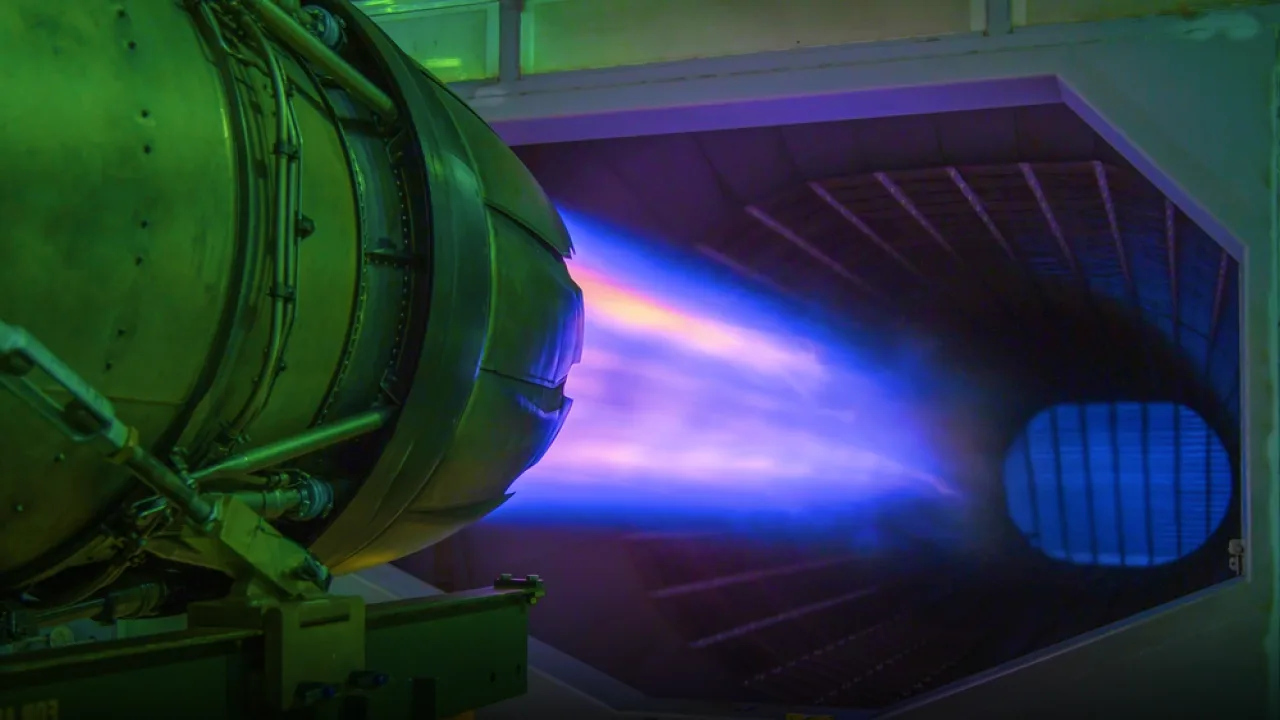
India’s Kaveri Derivative Engine has reportedly completed a new round of high-altitude and flight testing in Russia, producing peak dry thrust of 48.5 kN. The result would put the engine close to the thrust class DRDO has publicly identified for India’s future unmanned combat aircraft, but certification, aircraft integration and further flight testing still stand between an encouraging engine result and an operational Ghatak powerplant.
India’s decades-long Kaveri aero-engine programme may have crossed an important new milestone.
Recent Indian reporting says the Kaveri Derivative Engine, or KDE, produced peak dry thrust of 48.5 kilonewtons during high-altitude and flight trials in Russia, with testing conducted at the Central Institute of Aviation Motors and the Gromov Flight Research Institute.
The reported figure is significant because DRDO Chairman Samir V. Kamat said in 2025 that the dry Kaveri derivative was expected to produce about 49 kN of thrust for unmanned combat-aircraft applications.
The latest 48.5 kN result has not yet been detailed in a fresh public DRDO technical release. It should therefore be treated as a reported test result rather than an independently published official performance certification.
What is officially established is that the Ministry of Defence considers the Kaveri Derivative Engine the intended powerplant for India’s remotely piloted strike-aircraft programme, and that dedicated projects worth more than ₹700 crore have been sanctioned for flightworthy dry-engine development and technology demonstration.
The development is important because Kaveri is no longer being pursued as the engine for the current Tejas fighter. Its more realistic role is now emerging in a different class of aircraft: India’s future unmanned combat air vehicles.
Kaveri’s Role Has Changed
The original Kaveri programme was launched in 1989 to develop an indigenous engine for the Light Combat Aircraft.
That objective was not achieved.
The engine fell short of the thrust and performance required for Tejas, forcing India to use imported General Electric engines instead. The Tejas Mk1 family uses the GE F404, while more powerful future aircraft require still higher thrust classes.
DRDO did, however, accumulate substantial capability in compressors, combustors, turbines, control systems, materials and engine testing through the Kaveri programme.
Rather than discard that work, GTRE began adapting the engine for platforms with different performance requirements.
The most important result is the Kaveri Derivative Engine, which removes the afterburner and is intended to deliver roughly 49 kN of dry thrust.
This changes the problem considerably.
A supersonic manned fighter requires high thrust, including afterburning performance, while a subsonic stealth unmanned combat aircraft can be designed around a lower-thrust, non-afterburning powerplant.
DRDO has officially listed development of a flightworthy dry aero-engine for an Unmanned Combat Air Vehicle among GTRE’s propulsion technology programmes.
Why 48.5 kN Matters
The reported 48.5 kN result should be judged against the requirement of the derivative engine, not against what the original Kaveri was once expected to achieve for Tejas.
In August 2025, DRDO Chairman Samir V. Kamat publicly said the Kaveri derivative was expected to provide around 49 kN of thrust and would be used in unmanned combat-aircraft programmes.
Against that benchmark, a reported peak of 48.5 kN would put the latest engine very close to its stated dry-thrust objective.
That is different from saying the engine has completed development.
Peak thrust is only one part of qualifying an aircraft engine.
A military engine must deliver predictable performance across varying altitudes, speeds and temperatures. It must demonstrate reliability, endurance, safe acceleration and deceleration, stable combustion, resistance to inlet distortion and acceptable performance over repeated operating cycles.
It must also work as part of an aircraft rather than only as an isolated engine.
That means compatibility with the air intake, fuel system, digital controls, electrical architecture and thermal-management requirements of the final platform.
For a stealth aircraft, inlet integration is particularly important because the engine fan cannot simply be exposed directly to radar through a conventional straight intake.
The Kaveri programme has therefore moved closer to a usable UCAV engine if the latest result is confirmed, but thrust alone does not complete the programme.
Why the Tests Are Taking Place in Russia
Russia has played a role in Kaveri testing for many years because India does not possess an equivalent full-scale flying test-bed and high-altitude engine-testing infrastructure for all phases of military turbofan development.
The Central Institute of Aviation Motors has previously been used for simulated high-altitude Kaveri testing.
The Gromov Flight Research Institute has also hosted flight testing using an Il-76 flying test bed.
This is not new.
Official parliamentary records show that an earlier Kaveri prototype was mounted on an Il-76 in Russia and completed 27 flights covering approximately 57 hours, reaching altitudes of up to 12 kilometres.
Those trials established that an Indian-designed engine could be operated and evaluated in actual flight conditions even though the original configuration ultimately did not meet the requirements for Tejas.
The new dry-engine campaign builds on that experience.
If the latest reporting is accurate, testing has again combined simulated high-altitude work at CIAM with airborne evaluation through the Gromov infrastructure.
That is an important step because engine behaviour changes significantly as air pressure and temperature fall with altitude.
The Ghatak Connection
The larger reason the dry Kaveri matters is India’s unmanned combat-aircraft programme.
DRDO has been developing a stealthy, jet-powered flying-wing combat aircraft commonly associated with the Ghatak programme.
Unlike conventional remotely piloted drones designed primarily for long endurance, the concept is intended for higher-risk missions where low observability, internal weapons carriage and greater survivability become important.
DRDO material has previously described Ghatak as an autonomous, jet-powered stealth unmanned combat aircraft for the Indian Air Force.
A smaller technology demonstrator has already been used to validate aspects of the flying-wing configuration and autonomous control.
The propulsion requirement for the eventual operational aircraft is substantially different from the Tejas requirement.
The Ministry of Defence stated in July 2025 that the Kaveri Derivative Engine is the powerplant for the remotely piloted strike aircraft, and disclosed two sanctioned programmes: ₹472.42 crore for development of a flightworthy Kaveri dry engine and ₹251.17 crore for technology demonstration of the derivative.
This provides stronger evidence for the Kaveri-Ghatak connection than simply relying on unofficial defence reporting.
The engine has therefore found a programme that is better matched to the thrust level GTRE has actually achieved.
Certification Is Now the Critical Step
The next phase is less visually dramatic but arguably more important.
Reports on the Russian trials say the test data will now move into certification and integration work before further flight trials with the unmanned aircraft.
India’s military-airworthiness ecosystem includes CEMILAC, the Centre for Military Airworthiness and Certification, which is part of DRDO’s Aeronautical Systems cluster.
Certification requires far more than demonstrating maximum thrust.
Engine behaviour must be validated across an approved operating envelope. Components need defined life limits. Failure modes must be understood. Manufacturing quality must remain consistent from one engine to another.
Once integrated with Ghatak, the propulsion system will also have to demonstrate that it works reliably with the aircraft’s intake geometry and flight-control architecture.
This is especially relevant to a stealth flying-wing design.
Such aircraft can use curved or serpentine intake structures to conceal the engine face from radar. That helps reduce radar signature but can distort airflow reaching the engine, creating additional stability challenges for the compressor.
A flightworthy UCAV engine therefore has to work not simply on a test stand, but behind the real intake architecture of the aircraft it is intended to power.
This Does Not Put Kaveri Back Into Tejas
The latest progress should not be interpreted as a revival of Kaveri for the current Tejas fleet.
The propulsion requirements are different.
The original Kaveri could not achieve the required performance for the LCA programme, and Tejas moved ahead with imported GE engines years ago.
The dry derivative deliberately removes the afterburner and is being adapted around unmanned aircraft requirements.
A roughly 49 kN dry engine may be useful for Ghatak, but it is not a substitute for the much higher-thrust afterburning engines required by modern manned fighters.
India is separately pursuing a new-generation high-thrust aero-engine programme for future combat aircraft.
In early 2026, GTRE sought an Indian development and production partner for an advanced engine programme in roughly the 120 kN thrust class, a very different requirement from the Kaveri derivative.
The two programmes should therefore not be confused.
Kaveri can become successful in its new role without ever becoming the engine originally envisioned for Tejas.
Why Aero Engines Remain a Strategic Weakness
This distinction also explains why the Kaveri story matters beyond Ghatak.
India has developed indigenous fighter aircraft, missiles, radars, electronic-warfare systems and increasingly sophisticated unmanned platforms.
Military aero engines remain one of the most difficult gaps.
Modern turbofan development requires mastery of high-temperature materials, turbine blades, compressors, combustion stability, precision manufacturing, cooling technologies and digital engine controls.
Performance has to be achieved while keeping the engine light, reliable and durable.
Only a small group of countries possess mature design and production capability across the entire chain.
India’s dependence on imported fighter engines therefore creates a strategic vulnerability even when the aircraft surrounding those engines is increasingly indigenous.
Prime Minister Narendra Modi highlighted that weakness in his 2025 Independence Day address, calling for India to develop its own jet engines for indigenous fighter aircraft.
Kaveri alone will not solve that problem.
But the programme has created knowledge, test experience, industrial tooling and engineering capability that can feed into future engines.
That is why judging Kaveri only by its failure to power Tejas gives an incomplete picture.
The Industrial Base Matters Too
Another important change is that the derivative programme is no longer confined entirely to a government laboratory.
Indian industry is becoming involved in producing major engine modules.
Godrej Aerospace has worked with GTRE on manufacturing the Kaveri derivative, with the company describing the engine programme as substantially more complex than its earlier aerospace manufacturing work.
This industrial participation is strategically important.
An indigenous design cannot create genuine propulsion autonomy if key components can only be built as one-off laboratory pieces.
India ultimately needs companies capable of manufacturing compressors, combustors, turbine assemblies and other high-precision engine hardware repeatedly and to aviation-quality standards.
If Ghatak enters production, India would need not merely a successful prototype engine but a dependable production ecosystem capable of building, maintaining and overhauling engines throughout the aircraft’s service life.
Kaveri’s next challenge is therefore as much industrial as scientific.
What the Latest Result Actually Changes
If independently confirmed by DRDO, the reported 48.5 kN test result would establish something important: the dry Kaveri is broadly reaching the thrust level around which its unmanned-aircraft role has been planned.
That removes one major uncertainty.
It does not remove the others.
Certification remains unfinished. Ghatak integration remains ahead. Endurance and reliability will have to be proven. The engine will eventually need to demonstrate performance inside the actual aircraft rather than only through Russian test infrastructure.
The development should therefore be treated as an important engineering milestone, not as the completion of India’s jet-engine challenge.
Its strategic significance lies elsewhere.
Kaveri began as an engine that failed to meet the requirement of India’s first indigenous fighter. Decades later, the technology is being adapted into a propulsion system for a new generation of unmanned combat aircraft.
If the dry derivative successfully powers Ghatak, India will still depend on foreign engines for its current fighters.
But it will have demonstrated that it can design, manufacture, test and operationalise an indigenous military turbofan in a combat-aircraft programme.
For a country that has struggled for decades to close the aero-engine gap, that would be a meaningful capability in its own right.
The next milestone to watch is no longer simply another thrust number.
It is certification, integration with the Ghatak airframe and successful flight testing as part of the complete aircraft.
That is where Kaveri will have to prove that it has moved from an experimental engine programme to an operational propulsion system.
Sources
Ministry of Defence, Government of India - July 2025 official statement identifying the Kaveri Derivative Engine as the powerplant for the remotely piloted strike aircraft and confirming ₹472.42 crore and ₹251.17 crore sanctioned development projects. https://www.pib.gov.in/PressReleasePage.aspx?PRID=2148337&lang=2®=3
DRDO - propulsion technology roadmap identifying development of a flightworthy dry aero-engine for an Unmanned Combat Air Vehicle under GTRE. https://drdo.gov.in/drdo/en/offerings/technology-foresight/propulsion-technologies
Ministry of Defence, Government of India - February 2026 review of indigenous military gas-turbine development at GTRE, including continued Kaveri engine testing. https://www.pib.gov.in/PressReleasePage.aspx?PRID=2228670&lang=1®=1
The Indian Express - August 2025 interview with DRDO Chairman Samir V. Kamat stating that the dry Kaveri derivative was expected to deliver around 49 kN and would be used for unmanned combat-aircraft programmes. https://indianexpress.com/article/cities/pune/sukhoi-30-brahmos-operation-sindoor-drdo-chief-10179931/
Times of India - September 30, 2026 reporting that the Kaveri dry engine completed high-altitude and flight trials in Russia and recorded peak dry thrust of 48.5 kN; also reports certification and integration as the next stages. https://timesofindia.indiatimes.com/defence/news/indias-kaveri-engine-clears-trials-in-russia-ready-for-integration-with-stealth-ucav-ghatak/articleshow/134574087.cms
NDTV - independent contemporary reporting of the 48.5 kN result, tests at CIAM and Gromov Flight Research Institute, and the move towards certification and Ghatak integration. https://www.ndtv.com/india-news/russia-trials-over-this-engine-will-soon-power-indias-new-stealth-drones-12111462
Ministry of Defence, Government of India - historical official record of Kaveri high-altitude testing at CIAM and Il-76 flying-test-bed trials at the Gromov Flight Research Institute, including 27 flights and approximately 57 flight hours. https://www.pib.gov.in/newsite/PrintRelease.aspx?lang=2®=48&relid=90291
Ministry of Defence, Government of India - official record explaining that Kaveri did not meet Tejas requirements and that a dry derivative would instead be developed for India's unmanned strike-aircraft programme. https://www.pib.gov.in/newsite/PrintRelease.aspx?lang=2®=48&relid=98274
Business Standard - reporting on the Kaveri derivative industrial programme, including Godrej Aerospace manufacturing and the engine’s intended future role in the Ghatak programme. https://www.business-standard.com/blueprint-defence-magazine/reports/an-unfinished-mission-126080300340_1.html