
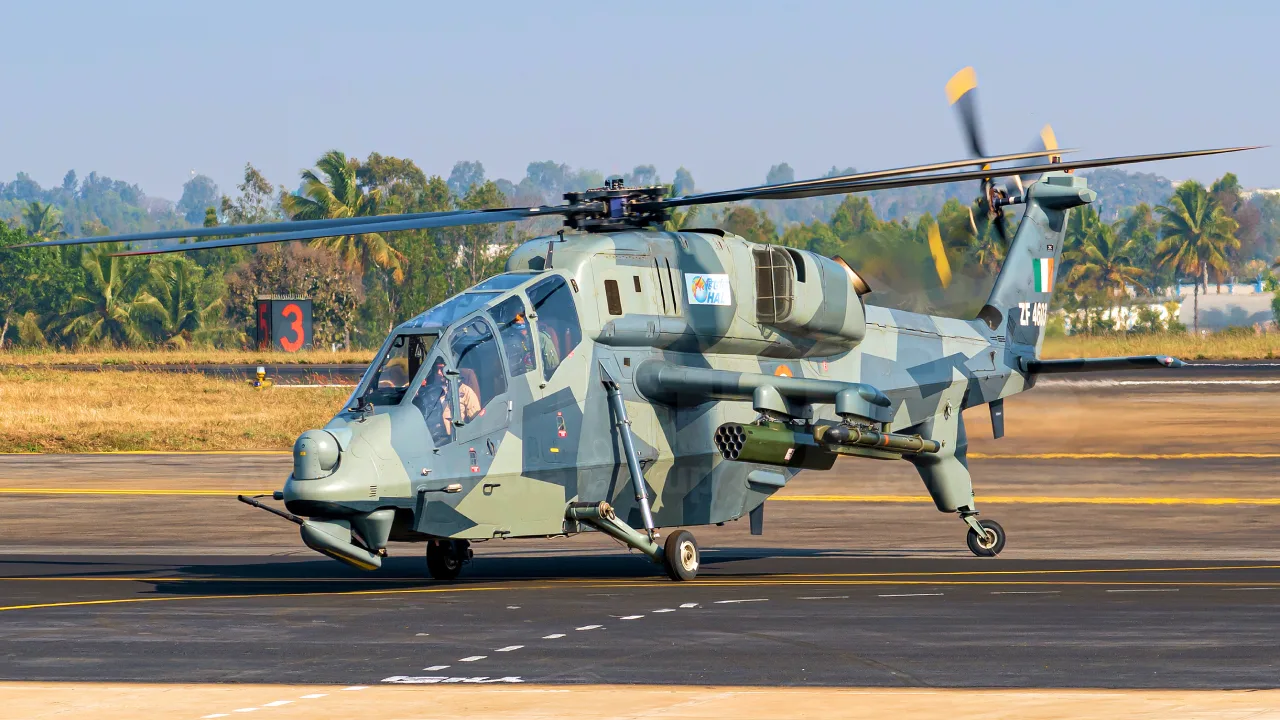
HAL will invest ₹218 crore in a second production line for the Shakti helicopter engine at Koraput as India prepares to manufacture 156 Prachand combat helicopters and sustain its larger Dhruv-family fleet. The expansion addresses a real propulsion-capacity requirement, but Shakti remains a HAL-Safran co-developed engine, making the distinction between domestic production capacity and complete engine-design sovereignty important.
India is preparing to expand not only helicopter production, but the propulsion capacity required to keep those production lines moving.
Hindustan Aeronautics Limited will establish a second production line for Shakti helicopter engines at its Koraput Division in Odisha, backed by an investment of ₹218 crore, according to the Ministry of Defence. Defence Minister Rajnath Singh is scheduled to mark the project on October 6, alongside the delivery of Koraput's 2,000th aero-engine. The new capacity is intended to support the Dhruv Advanced Light Helicopter and Prachand Light Combat Helicopter fleets.
The timing is significant. In March 2025, the Ministry of Defence signed two contracts with HAL worth ₹62,700 crore, excluding taxes, for 156 Prachand helicopters, comprising 90 for the Indian Army and 66 for the Indian Air Force. Deliveries are scheduled to begin from the third year of the contract and continue over the following five years. More than 250 Indian companies, predominantly MSMEs, are expected to participate in the program.
Each Prachand uses two Shakti engines, according to HAL's official technical specifications. The 156-helicopter production program therefore represents a requirement for at least 312 installed engines before accounting for spare engines, replacements, overhaul requirements or demand from other Shakti-powered helicopters.
That arithmetic explains why the new Koraput line matters.
A helicopter production surge cannot be sustained by expanding airframe assembly alone. Engines, transmissions, rotor systems, avionics and other long-lead equipment have to scale with it. The second Shakti line is therefore better understood as part of the industrial infrastructure behind India's expanding helicopter fleet, rather than as an isolated ₹218 crore factory investment.
The Prachand Order Changes the Scale of the Engine Requirement
India has been producing Shakti-powered helicopters for years, but the 156-aircraft Prachand contract creates a much larger and more predictable propulsion requirement.
The Ministry of Defence says the Prachand contracts are intended to achieve more than 65 percent indigenous content during execution, involve over 250 domestic companies and generate more than 8,500 direct and indirect jobs. The aircraft is designed for high-altitude combat and can operate above 5,000 metres, a requirement that has shaped both the helicopter and its propulsion system.
HAL lists the Prachand at a maximum take-off weight of 5,800 kg, a maximum speed of 268 km/h and a service ceiling of 6.5 km. Its powerplant is listed as two Shakti engines rated at 1,032 kW each. The helicopter also shares substantial design commonality with HAL's Advanced Light Helicopter family.
The engine requirement therefore extends beyond 312 units.
Operational fleets require spare powerplants and modules so that helicopters are not immobilized whenever an engine enters inspection, repair or overhaul. Shakti also powers the Dhruv family, including military derivatives, which creates continuing demand independently of the Prachand production run. Safran identifies the Ardiden 1H1/Shakti as the engine used on both Dhruv and the Light Combat Helicopter.
The Ministry of Defence has not publicly disclosed the planned annual output of the new Koraput Shakti line, its commissioning date or the division of future production between Koraput and existing facilities. It is therefore too early to quantify how much the project will increase national Shakti output or to claim that it eliminates a specific production bottleneck. What the government has confirmed is that the additional capacity is being created to meet growing Dhruv and Prachand requirements.
That distinction is important. The ₹218 crore announcement establishes a capacity expansion. It does not yet establish its production rate.
Shakti Is Indian-Made, but It Is a HAL-Safran Engine
The Shakti story also requires precision because the term "indigenous engine" can conceal different levels of technological control.
Shakti is the Indian production designation of the Ardiden 1H1, developed through the long-running partnership between HAL and Safran Helicopter Engines. Safran describes the engine as co-developed with HAL, with a power range of roughly 1,400 to 2,000 shaft horsepower, dual-channel Full Authority Digital Engine Control and performance optimized for demanding "hot and high" operating conditions.
Safran's current India profile says the Shakti/Ardiden 1H1 is produced in Bengaluru using components manufactured mainly in India. It also says more than 1,200 Safran-designed helicopter engines are currently in service with the Indian Armed Forces across its broader engine portfolio.
The new Koraput facility will therefore create another production location for an engine whose existing Indian manufacturing base is centered in Bengaluru. In principle, spreading production across another HAL site can provide additional capacity and reduce dependence on a single manufacturing location, although neither the Ministry of Defence nor HAL has publicly quantified that resilience benefit.
India has also progressively accumulated production experience around Shakti. In 2022, Safran said HAL had already produced more than 500 Shakti engines, illustrating that this is a mature manufacturing partnership rather than a new technology-transfer arrangement. Safran and HAL have separately developed an Indian MRO framework for Shakti and other helicopter engines.
But manufacturing maturity should not be equated with possessing complete sovereign ownership of the design.
Shakti is not comparable to a hypothetical clean-sheet turboshaft conceived, designed, certified and industrialized entirely by an Indian organization. It is a successful Indo-French co-development and localization program. That still has strategic value because India manufactures the engine domestically, builds local supply chains and can sustain a large helicopter fleet at home, but it represents a different level of propulsion autonomy from wholly controlling the underlying engine technology and intellectual property.
This distinction becomes especially important as India moves toward its next generation of helicopter engines.
Koraput Is Becoming a Wider Aero-Engine Production Hub
The choice of Koraput is significant because the division already occupies an important place in India's military-engine industrial base.
HAL says its Koraput Engine Division was established in April 1964 to manufacture R11-F2/F2S turbojet engines for the MiG-21FL. It later produced R25 engines for the MiG-21BIS and R29B engines for the MiG-27M, developed overhaul facilities for several Soviet-origin powerplants and began manufacturing RD-33 Series 3 engines for the MiG-29 from 2007-08. HAL also established forge and foundry capabilities there to support aero-engine manufacturing from the raw-material stage.
HAL's existing Koraput webpage records more than 7,700 aero-engine overhauls over the division's history. Its manufacturing figure on that page is older, but the Ministry of Defence's October 5 announcement confirms that the October 6 event will mark delivery of the 2,000th aero-engine from the division.
Koraput is simultaneously involved in another major propulsion program.
In September 2024, the Ministry of Defence signed a contract worth more than ₹26,000 crore for 240 AL-31FP engines for the Su-30MKI fleet. Those engines are to be produced at Koraput at a contractual rate of 30 per year, with all 240 scheduled over eight years. HAL is expected to raise indigenous content to 63 percent by the end of that program, with average indigenous content exceeding 54 percent.
The addition of Shakti therefore broadens Koraput's role from a center overwhelmingly associated with fixed-wing combat-aircraft engines to one that will also support indigenous helicopter propulsion.
That matters industrially. Aero-engine manufacturing depends on specialized machining, metallurgy, quality assurance, precision assembly, testing and a workforce accustomed to aviation tolerances. A facility with sustained engine workloads can preserve those skills more effectively than one dependent on intermittent production programs. The Shakti expansion and AL-31FP contract together give Koraput major propulsion work across both fighter and helicopter fleets.
At the same time, Koraput's history also illustrates an enduring limitation in India's propulsion sector. Much of its engine-manufacturing expertise was accumulated through foreign-origin designs and licensed or collaborative production. Increasing Indian manufacturing content is valuable, but it is not identical to mastering every stage of original aero-engine design.
The next generation of HAL-Safran cooperation is intended to move further in that direction.
Aravalli Shows Where India Wants the Partnership to Go Next
In August 2026, HAL and Safran signed a final contract through their SAFHAL joint venture for development and production of the new Aravalli turboshaft engine.
Unlike Shakti, Aravalli is being developed for a much heavier class of future Indian helicopter. The planned engine will produce roughly 3,500 to 4,000 shaft horsepower and has been selected for HAL's proposed 13-ton Indian Multi-Role Helicopter and its naval Deck-Based Multi-Role Helicopter derivative. The agreement covers design, development, manufacturing, supply and lifecycle support.
Safran described the agreement as the first time it had undertaken co-development of an engine in this power class through such a partnership. The program is intended to include advanced design, manufacturing, testing and long-term support activities in the joint venture.
The contrast between Shakti and Aravalli helps explain the trajectory of India's helicopter-engine strategy.
Shakti provides a proven engine family that India can manufacture at increasing scale for current platforms. The second production line strengthens that industrial base.
Aravalli is intended to push the partnership toward joint development of a new engine for future platforms.
The two objectives are complementary, but they should not be confused.
India needs near-term production capacity because Prachand and Dhruv require engines now. It also needs deeper design capability so that its future helicopter programs are not permanently dependent on foreign-owned propulsion architectures.
A mature national propulsion ecosystem requires both.
The Real Test Is Whether Helicopter Production Can Scale as a System
The strategic case for the Koraput investment ultimately rests on India's ability to turn large helicopter orders into sustained industrial production.
The ₹62,700 crore Prachand program is particularly important because it gives HAL and its suppliers a long production horizon. More than 250 domestic companies are expected to participate, while the government plans indigenous content above 65 percent during execution.
That supply chain has to scale coherently.
Producing additional fuselages is of limited value if engines arrive late. Engines cannot compensate for shortages in transmissions, rotors, avionics or weapons. Nor does increasing assembly capacity matter unless suppliers can produce aviation-grade components at the required rate and quality for years.
The second Shakti line addresses one part of that industrial equation.
It also has implications beyond new-aircraft deliveries. India's military helicopter fleet will require engine maintenance, repair, overhaul, replacement modules and spares throughout decades of service. Production capability and sustainment capability therefore reinforce each other. A larger domestic engine base can reduce exposure to overseas supply disruptions, but the depth of that resilience depends on how much of the critical component and technology chain is actually controlled in India.
This is why the most useful measure of the new Koraput line will not simply be whether its foundation stone is laid.
The key questions are how quickly it is commissioned, how many engines it can produce each year, what share of their value is sourced domestically, how production is divided with Bengaluru, and whether engine output remains synchronized with the 156-aircraft Prachand schedule.
The government's announcement does not yet provide those figures.
What the available evidence does establish is that India is now planning propulsion capacity around a much larger indigenous helicopter fleet.
The Prachand order alone creates demand for at least 312 installed Shakti engines. Dhruv-family production and fleet sustainment add further requirements. Koraput already has decades of engine manufacturing and overhaul infrastructure, while HAL and Safran are simultaneously moving toward a more ambitious joint engine-development program through Aravalli.
The second Shakti line is therefore more consequential than its ₹218 crore price tag might suggest.
It is an enabling investment behind the much larger question of whether India can manufacture military helicopters at scale and sustain them domestically once they enter service.
But it is also a reminder of where India's aerospace ambitions still have to go. Building more Shakti engines strengthens domestic manufacturing capacity. Achieving deeper propulsion sovereignty will require India to convert that manufacturing experience into increasingly greater control over engine design, materials, certification, intellectual property and future development.
The Shakti line helps India scale the helicopters it has today.
Programs such as Aravalli will help determine how much of the propulsion technology in the helicopters of tomorrow India can genuinely call its own.
Sources
Ministry of Defence, Press Information Bureau, October 5, 2026 - confirms the ₹218 crore second Shakti production line at HAL Koraput, its role in supporting Dhruv and Prachand requirements, and the 2,000th aero-engine milestone. https://www.pib.gov.in/PressReleseDetailm.aspx?PRID=2319187&lang=1®=3
Ministry of Defence, Press Information Bureau, March 28, 2025 - confirms the ₹62,700 crore contracts for 156 Prachand helicopters, including 90 for the Army and 66 for the Air Force, the delivery framework, planned indigenous content and participation of more than 250 domestic companies. https://www.pib.gov.in/Pressreleaseshare.aspx?PRID=2116411&lang=2®=48
Hindustan Aeronautics Limited - official LCH Prachand specifications, including two Shakti engines per aircraft, 1,032 kW engine power and helicopter performance parameters. https://hal-india.co.in/product/lch
Safran Helicopter Engines - official Ardiden 1H1/Shakti technical profile; confirms HAL co-development, engine power class, dual-channel FADEC and use on Dhruv and LCH. https://www.safran-group.com/products-services/ardiden-1h1-shakti-engine-indian-dhruv-helicopter
Safran - current India industrial profile; confirms that Shakti/Ardiden 1H1 was co-developed with HAL and is produced in Bengaluru using components manufactured mainly in India. https://www.safran-group.com/countries/india
Hindustan Aeronautics Limited - official history of the Koraput Engine Division, including its establishment in 1964, fighter-engine manufacturing programs and more than 7,700 aero-engine overhauls. https://hal-india.co.in/production-unit-details/engine-division-koraput
Ministry of Defence, Press Information Bureau, September 9, 2024 - confirms the ₹26,000 crore contract for 240 AL-31FP engines, production at Koraput, 30-engine annual delivery rate and planned increase in indigenous content. https://www.pib.gov.in/PressReleaseIframePage.aspx?PRID=2053088&lang=2®=48
Safran, August 26, 2026 - final HAL-Safran/SAFHAL contract for development, manufacture and lifecycle support of the 3,500 to 4,000 shp Aravalli engine for the IMRH and DBMRH. https://www.safran-group.com/pressroom/hal-and-safran-helicopter-engines-sign-final-contract-safhal-launching-development-and-production-2026-08-26
Business Standard, October 5, 2026 - independent reporting on the Koraput Shakti line, the Prachand production requirement and the broader evolution of HAL's aero-engine manufacturing base. https://www.business-standard.com/external-affairs-defence-security/news/hal-to-add-second-shakti-engine-line-as-india-boosts-aero-engine-capacity-126100501064_1.html