
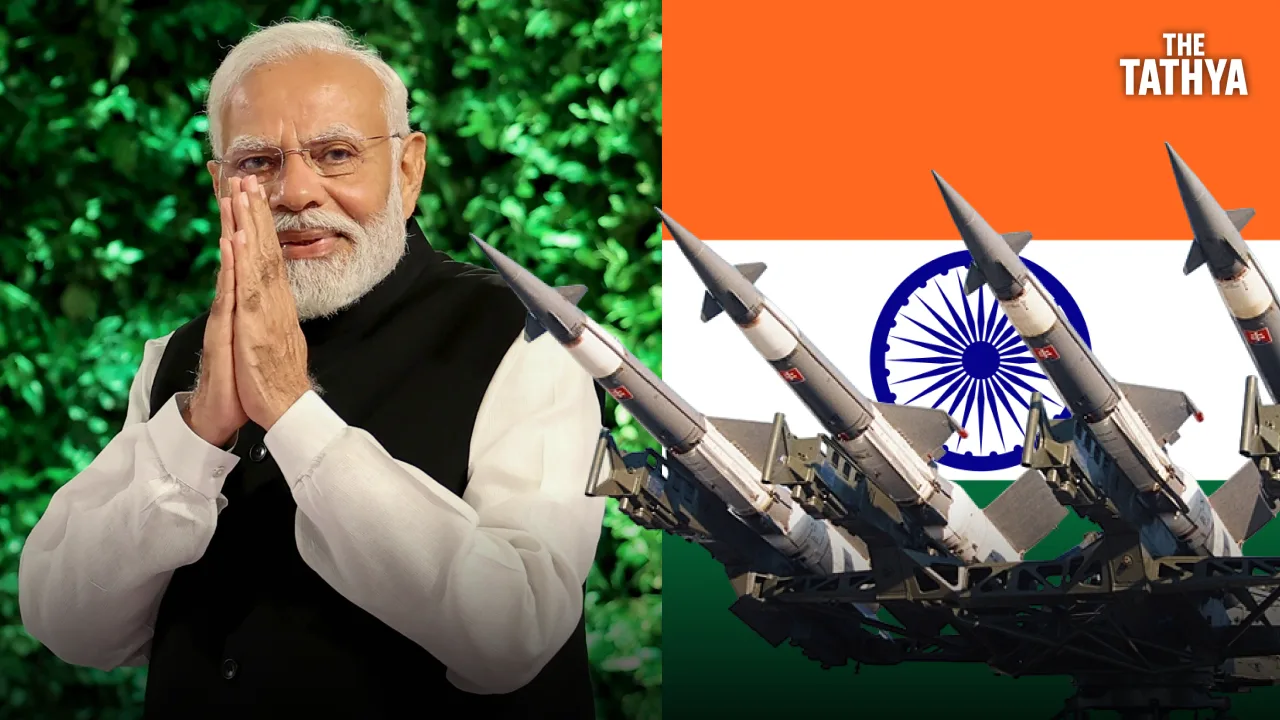
India’s defence exports rose 62.66% to a record ₹38,424 crore in FY2025-26, extending a transformation from just ₹686 crore twelve years earlier. Defence Secretary Rajesh Kumar Singh now believes ₹50,000 crore could be reached as early as 2028, but getting there will depend on whether India can convert growing interest in missiles, artillery and other systems into repeatable large-scale exports.
India’s defence-export story has reached another inflection point.
Defence exports touched a record ₹38,424 crore in FY2025-26, according to the Ministry of Defence, an increase of ₹14,802 crore from ₹23,622 crore the previous year. That represents year-on-year growth of 62.66%. Defence Public Sector Undertakings contributed ₹21,071 crore, or 54.84% of the total, while private companies accounted for ₹17,353 crore, or 45.16%.
The longer-term increase is more striking. India exported defence equipment worth ₹686 crore in FY2013-14. By FY2025-26, that figure had increased more than 56-fold, with the government saying Indian defence products now reach more than 80 countries and the number of exporters has expanded to 145.
The government’s formal target has generally been stated as ₹50,000 crore in annual defence exports by 2029. Defence Secretary Rajesh Kumar Singh, however, said at a Public Affairs Forum of India conference on September 25 that he believes India could reach the level “possibly by 2028”.
From the FY2025-26 level, reaching ₹50,000 crore requires another roughly 30% increase in annual exports. If achieved over around two years, that would imply an average growth rate of about 14% a year, considerably slower than the exceptional growth recorded in FY2025-26.
The arithmetic therefore looks achievable. The harder question is whether India’s defence industry can build a sufficiently broad and repeatable export base to sustain it.
India Is Exporting More Than Complete Weapon Systems
The headline export figure can create the impression that India is already shipping large numbers of fighter aircraft, missile batteries and warships overseas.
The reality is more diverse.
Indian defence exports include complete systems, but also ammunition, electronic equipment, radars, protective equipment, patrol vessels, components, sub-systems and parts integrated into global supply chains.
This distinction matters because export growth does not depend only on winning a handful of major weapons contracts.
India can expand its defence trade both by selling complete platforms and by becoming a reliable supplier of components, ammunition, maintenance services and sub-systems to foreign militaries and global defence companies.
The Ministry of Defence says exports now reach more than 80 countries. Earlier government material has identified the United States, France and Armenia among important destinations, illustrating how different the export relationships can be. Some countries buy Indian-designed military systems, while others import components and equipment produced by Indian firms.
The growing private-sector contribution is equally significant. Private firms now account for almost half of India’s defence exports even though public-sector companies continue to dominate overall defence production.
That suggests the export economy is becoming broader than the traditional state-owned defence industrial base.
Missiles Could Become India’s Most Important Export Advantage
The strongest opportunity may lie in missiles.
Singh said India can produce some missile systems at significantly lower costs than comparable systems supplied by foreign original equipment manufacturers. He claimed that in certain cases Indian missiles could be offered at around one-fourth the price of comparable foreign alternatives.
That figure is an assessment made by the Defence Secretary rather than an independently published comparison of specific missile systems. Singh did not identify the missile or the competing foreign system, so the exact cost advantage cannot be independently tested from publicly available information.
The broader point, however, is credible. If India can offer militarily capable systems at substantially lower acquisition and lifecycle costs, price could become an important advantage in countries that need modern weapons but cannot afford US or European systems at scale.
BrahMos is currently the clearest example of India moving into the market for high-value weapons exports.
In January 2022, BrahMos Aerospace signed a contract with the Philippines for a shore-based anti-ship missile system. The agreement was significant because it represented an export of one of India’s most strategically important missile systems rather than a component or low-value platform.
Singh said in September that BrahMos remains highly sought after and that India is selling, or is in the process of selling, the system to several Southeast Asian countries. Earlier this year, he also publicly stated that a BrahMos supply agreement had been signed with Vietnam, although the detailed contract has not been released publicly.
The Akash surface-to-air missile is also attracting interest from potential buyers, according to Singh, while artillery and truck-mounted gun systems are seeing stronger overseas demand.
These are potentially important markets because they move Indian exports further up the value chain.
Selling helmets, components and ammunition can build industrial scale. Exporting missiles, air-defence systems and artillery establishes India as a supplier of strategically consequential weapons.
The Industrial Base Has to Scale With the Export Ambition
The defence-export target cannot be separated from India’s wider manufacturing expansion.
Domestic defence production reached a record ₹1.78 lakh crore in FY2025-26, up 15.6% from the previous year and nearly four times the level recorded in 2014-15. Public-sector entities still accounted for around 76% of production, while the private sector’s share increased to 24%.
Singh has outlined an ambition for a much broader production ecosystem. He said India should have at least two or three fighter-aircraft production lines, around half a dozen missile manufacturers and hundreds of drone producers.
This should be understood as an industrial objective rather than a statement that all these production lines already exist.
The government is also seeking more private participation in ammunition and propellant production, areas where concentrated production can create capacity constraints during periods of high military demand.
That expansion matters because export credibility depends on more than developing a good weapon.
A foreign customer buying a missile battery or artillery system wants assurance that the supplier can deliver on schedule, produce enough ammunition, maintain equipment for decades, train operators and provide upgrades and spare parts.
India’s challenge is therefore shifting from proving that it can design competitive systems to proving that it can produce and support them at industrial scale.
Defence Exports Are Also Foreign Policy
Weapons exports have consequences that ordinary merchandise exports do not.
A country that buys a missile or artillery system is rarely making a one-time purchase. It normally requires training, ammunition, maintenance, spare parts, software support and future upgrades.
Singh explicitly highlighted this dimension, arguing that exports create long-term relationships because supplier countries continue supporting equipment throughout its operational life.
That creates strategic value for India.
The Philippines’ BrahMos purchase, for example, is not simply an export transaction. It creates a long-term defence relationship around training, missile support, maintenance and future operational requirements in a country occupying an important position in the Indo-Pacific.
Similar relationships with Southeast Asian, African, Middle Eastern or other partner countries could gradually strengthen India’s defence diplomacy.
This is one reason major arms-exporting states treat defence trade differently from ordinary commerce. Weapons sales can create decades-long institutional relationships between armed forces, defence ministries and manufacturers.
India is beginning to enter that space.
But India Is Still a Major Arms Importer
The export rise should not be confused with India having completed its transition from weapons buyer to weapons supplier.
India remains heavily dependent on imported military technology in several critical areas.
SIPRI estimates that India was the world’s second-largest recipient of major arms in 2021-25, accounting for 8.2% of global imports of major weapons. Imports fell 4% compared with 2016-20, partly reflecting greater domestic production, but India continues to depend on foreign suppliers for important combat aircraft, engines, submarines, sensors and other technologies.
India can therefore be a rapidly growing defence exporter and a major defence importer at the same time.
There is no contradiction.
The Indian defence sector is increasingly competitive in particular segments such as missiles, artillery, naval platforms, ammunition, electronics and components, while remaining dependent on foreign technology elsewhere.
The more meaningful measure of progress will be whether India moves steadily into more complex exports while reducing critical import dependencies at home.
What ₹50,000 Crore Would Actually Mean
Crossing ₹50,000 crore would be an important milestone, but the quality of exports will matter as much as the value.
A sustainable defence exporter needs more than one-off orders.
India will need repeat customers, follow-on ammunition contracts, maintenance agreements, additional missile buyers and a broader range of systems capable of competing internationally on price, performance and delivery time.
It will also need sufficient manufacturing capacity to meet export demand without creating delays for the Indian Armed Forces.
The current global environment offers an opportunity. Defence expenditure is increasing in many regions, European states are rebuilding military inventories, and countries across Asia are investing in missiles, air defence, drones and artillery.
But that market is highly competitive. The United States remains overwhelmingly dominant in major-arms exports, while France, Germany, Israel, South Korea, Türkiye and other suppliers are also competing aggressively for contracts. SIPRI estimates the United States alone accounted for 42% of global major-arms exports during 2021-25.
Price can help India, but price alone will not be enough.
Buyers will judge Indian systems on combat performance, reliability, delivery schedules, financing, diplomatic conditions and decades of after-sales support.
That is why the next stage of India’s defence-export story is harder than the first.
Going from ₹686 crore to ₹38,424 crore demonstrated that India could build an export industry. Going from ₹38,424 crore to ₹50,000 crore and beyond will increasingly require India to become a long-term military systems supplier.
The target may arrive by 2028.
What will matter more is whether the industrial and strategic relationships behind that number endure for decades.
Sources
Ministry of Defence, Government of India - official FY2025-26 defence-export figure of ₹38,424 crore, annual growth, public/private-sector shares, exporter count and overseas reach. https://www.pib.gov.in/PressReleasePage.aspx?PRID=2248124&lang=2®=48
Ministry of Defence, Government of India - defence-production growth, defence-export growth since FY2013-14, 145 exporters, 80-plus export destinations and government target of ₹50,000 crore by 2029. https://www.pib.gov.in/PressNoteDetails.aspx?ModuleId=3&NoteId=158925&lang=1®=3
Ministry of Defence, Government of India - Defence Minister’s August 2026 confirmation of ₹38,424 crore exports and the ₹50,000 crore export target. https://www.pib.gov.in/PressReleasePage.aspx?PRID=2299488&lang=2®=48
Moneycontrol - Defence Secretary Rajesh Kumar Singh’s September 25 assessment that ₹50,000 crore could be reached by 2028; supports his comments on missile pricing, Akash, artillery, industrial capacity and lifecycle relationships created through exports. https://www.moneycontrol.com/news/business/india-could-hit-rs-50-000-crore-defence-export-target-two-years-early-defence-secretary-14038458.html
Ministry of Defence, Government of India - official confirmation of the BrahMos Aerospace contract to supply the Philippines with a shore-based anti-ship missile system. https://www.pib.gov.in/PressReleasePage.aspx?PRID=1793209&lang=1®=3
The Indian Express - reports Defence Secretary Rajesh Kumar Singh’s statement that India signed an agreement with Vietnam for BrahMos supply and that discussions with Indonesia were progressing. https://indianexpress.com/article/india/india-has-signed-deal-with-vietnam-for-supply-of-brahmos-defence-secretary-rajesh-kumar-singh-10716288/
Ministry of Defence, Government of India - government data on the breadth of Indian defence exports and examples of exported equipment and major destinations. https://www.pib.gov.in/PressNoteDetails.aspx?ModuleId=3&NoteId=154617&lang=1®=6