
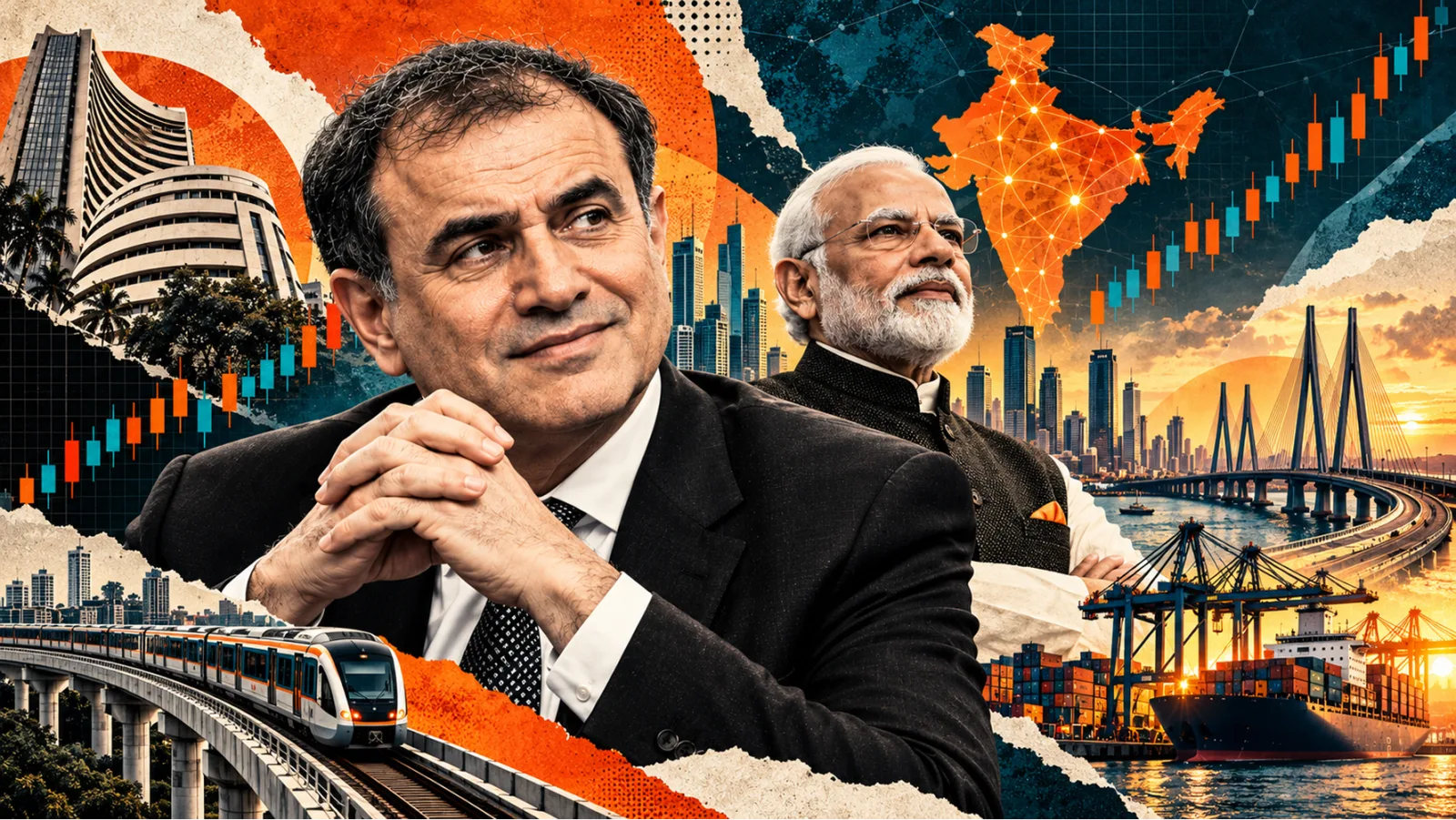
Renowned economist Nouriel Roubini believes the coming decades could belong to India, just as China's economic rise defined much of the previous generation. His assessment comes as India strengthens its position in global manufacturing, technology, trade and investment.
Economist Nouriel Roubini, internationally recognised for warning about the 2008 global financial crisis before it unfolded, has delivered a strikingly optimistic assessment of India's economic future.
Popularly known as "Dr Doom" for his warnings about financial instability and global economic risks, Roubini now sees India emerging as one of the most promising growth stories in the world economy.
Speaking to The Economic Times on the sidelines of the SuperReturn Middle East event in Dubai, Roubini described India as a "major success story with the potential to become an even bigger one."
More significantly, he suggested that India's economic rise could become as important to the coming decades as China's transformation was to the preceding decades.
His remarks reflect a broader shift in international economic thinking, with India increasingly being viewed not merely as an emerging market but as a major economy capable of influencing global growth, manufacturing networks and geopolitical alignments.
Why Roubini's Assessment Matters
Roubini earned international recognition after warning in 2006 about vulnerabilities in the American financial system, including excessive borrowing, deteriorating lending standards and the risks associated with the housing market.
The financial crisis that erupted in 2008 subsequently validated important elements of those warnings.
His latest observations are particularly noteworthy because he is generally associated with caution about economic vulnerabilities rather than unqualified optimism.
Roubini identified India's large domestic market, expanding talent pool, relatively strong macroeconomic fundamentals and commitment to economic openness as important advantages.
He also argued that India's position could strengthen as international manufacturers diversify their operations away from China.
This assessment comes at a time when geopolitical tensions, trade disputes and supply-chain disruptions are forcing multinational companies and governments to reconsider where they manufacture, invest and source critical products.
India's Economic Growth Is Already Outpacing Major Economies
Roubini's optimism is supported by recent international economic projections.
In its October 2026 World Economic Outlook, the International Monetary Fund upgraded India's growth forecast for FY2026-27 to 7%, from its earlier estimate of 6.4%. It also projected 7% growth for FY2027-28.
The Reserve Bank of India, meanwhile, projected 7.1% growth for FY2026-27.
These projections stand in sharp contrast to the IMF's expected global growth rate of 3.1% in calendar year 2026.
While many advanced economies face structural constraints, demographic pressures and sluggish expansion, India's large domestic market and consumption base provide an important foundation for sustained growth.
The country's expanding infrastructure, digital economy and manufacturing ambitions add further dimensions to its growth prospects.
The significance is not simply that India is growing faster than many other large economies. It is that sustained expansion could increase India's weight in international trade, capital flows, technological development and global economic decision-making.
Global Manufacturing Is Shifting, and India Has an Opportunity
One of the most important elements of Roubini's assessment concerns the restructuring of global supply chains.
For decades, China established itself as the world's manufacturing powerhouse through industrial expansion, export competitiveness and integration into international supply networks.
However, trade tensions, geopolitical uncertainty and concerns about excessive dependence on a single manufacturing destination have encouraged companies to diversify.
This has increased interest in alternative production locations, including India.
The trend is often described as friendshoring, in which companies shift supply chains towards countries considered economically or strategically reliable.
India's growing manufacturing ecosystem, workforce, domestic market and international partnerships provide an opportunity to benefit from this restructuring.
There is already measurable progress.
According to India's Ministry of Electronics and Information Technology, domestic electronics production increased from approximately ₹1.9 lakh crore in FY2014-15 to ₹12 lakh crore in FY2024-25.
Over the same period, mobile phone exports rose from approximately ₹1,500 crore to ₹2 lakh crore.
India has also emerged as the world's second-largest mobile phone manufacturer.
These developments demonstrate how domestic industrial policy, private investment and global supply-chain diversification can contribute to India's manufacturing expansion.
Nevertheless, India still needs to deepen domestic component production and technological capabilities. Government estimates placed domestic value addition in electronics manufacturing at approximately 18-20% in April 2026.
The next challenge is therefore to move beyond assembling products towards controlling a greater share of their underlying technology, components and industrial value chains.
India's Digital Infrastructure Provides Another Competitive Advantage
India's economic transformation is not limited to conventional manufacturing.
The country has developed one of the world's most extensive digital public infrastructure ecosystems, with the Unified Payments Interface (UPI) becoming a major example of innovation at population scale.
According to government figures, UPI processed approximately 24,162 crore transactions worth ₹314 lakh crore during FY2025-26.
By July 2026, monthly UPI transaction volumes had reached approximately 2,366 crore.
This digital infrastructure has supported financial inclusion, reduced payment friction and enabled businesses of different sizes to participate in digital commerce.
Combined with India's expanding technology services industry, startup ecosystem and growing interest in artificial intelligence, such infrastructure provides another foundation for economic development.
India's opportunity is therefore broader than replicating China's manufacturing-led expansion.
It can potentially combine industrial growth with technological services, digital platforms, domestic consumption and innovation-driven productivity improvements.
Roubini Also Has a Warning: India Must Create More Jobs
Despite his optimism, Roubini stressed that India's existing growth trajectory may not be sufficient to fully realise its economic potential.
He argued that India needs to move closer to 9% economic growth to generate enough quality employment opportunities for its young population.
The warning is particularly relevant as artificial intelligence and automation begin transforming labour markets, including both manufacturing and knowledge-based occupations.
India's demographic advantage can support long-term expansion, but its full economic benefit depends on education, skills, productivity and employment creation.
Roubini also suggested that continued structural reforms and greater economic openness could lift India's potential growth beyond 8%.
The underlying message is clear: India's demographic scale creates a substantial opportunity, but converting that opportunity into prosperity requires sustained improvements in industrial competitiveness and productivity.
The Tathya Analysis: The World Is Beginning to Recognise India's Economic Potential
Nouriel Roubini's assessment is significant beyond the immediate optimism surrounding India's growth projections.
It reflects an important development in the international economic outlook: India is increasingly being recognised as a long-term centre of global economic opportunity.
For several decades, discussions about Asia's economic transformation were overwhelmingly dominated by China's manufacturing expansion.
India's growth was frequently viewed through the lens of unrealised potential, infrastructure constraints and development challenges.
That perception is gradually changing.
India now combines several structural advantages that are difficult to replicate simultaneously: a vast domestic market, a relatively young population, a substantial technology workforce, expanding infrastructure and growing geopolitical importance.
The Modi government's initiatives in infrastructure development, manufacturing incentives, digital public infrastructure and domestic industrial capacity have contributed to this transformation, although their long-term success will ultimately depend on measurable productivity gains, higher-value manufacturing and employment creation.
India's Rise Is About More Than GDP
From India's perspective, the most important aspect of this transformation is the relationship between economic strength and strategic autonomy.
A country with stronger manufacturing capabilities, competitive domestic industries, resilient infrastructure and advanced technological capacity is better positioned to protect its national interests.
Economic development directly influences defence preparedness, technological independence, energy security and international bargaining power.
This makes India's ambitions in semiconductors, defence manufacturing, renewable energy, artificial intelligence and advanced infrastructure particularly significant.
The objective should not merely be to increase India's share of global production. It should be to progressively reduce dependence on foreign countries for strategically important technologies and industrial components.
India Does Not Need to Become Another China
Roubini's comparison with China should be understood as an assessment of India's potential importance, not a prediction that India will follow exactly the same economic trajectory or automatically replace China.
China retains enormous advantages in manufacturing scale, industrial ecosystems and export infrastructure.
India's opportunity lies in developing a competitive model suited to its own strengths.
Unlike China's historically export-oriented industrial expansion, India's economic development can draw on a combination of domestic demand, technology-led services, manufacturing growth and international economic partnerships.
Its democratic institutions, entrepreneurial ecosystem and diverse international relationships may also offer advantages in an increasingly fragmented geopolitical environment.
However, these advantages are not substitutes for industrial efficiency, greater investment in research and development, improved skills or stronger export competitiveness.
The Next Decade Will Be Decisive
India's immediate challenge is to convert international confidence into sustained investment, productive capacity and high-quality employment.
Attracting global manufacturers is only one part of this objective.
The larger goal must be to build Indian companies capable of competing internationally, develop domestic technological expertise and move progressively towards higher-value segments of global supply chains.
India must also remain alert to external vulnerabilities, particularly energy import dependence, global trade disruptions and the economic consequences of geopolitical instability.
These are substantial challenges, but they do not diminish the country's long-term possibilities.
Roubini's assessment highlights that India's growth potential is now attracting serious attention from economists and investors who examine the global economy through the lens of structural risks and opportunities.
India's rise is no longer being discussed solely as a distant aspiration. It is increasingly becoming part of the global economic outlook.
The country has an opportunity to shape the coming decades through sustained economic growth, industrial development, technological capability and strategic independence.
Whether the coming decades ultimately become India's will depend not on forecasts or international praise, but on its ability to transform today's advantages into lasting national capabilities.
For India, that is both the opportunity and the responsibility ahead.
Sources
- The Economic Times - Markets Will Push the US to Act Constructively: Nouriel Roubini (October 16, 2026)
- International Monetary Fund - World Economic Outlook, October 2026
- The Indian Express - IMF Raises India Growth Forecast to 7% (October 13, 2026)
- Ministry of Electronics and Information Technology - Electronics Manufacturing and Domestic Value Addition (April 1, 2026)
- Ministry of Finance - Ten Years of UPI and India's Digital Payments Expansion (August 24, 2026)