
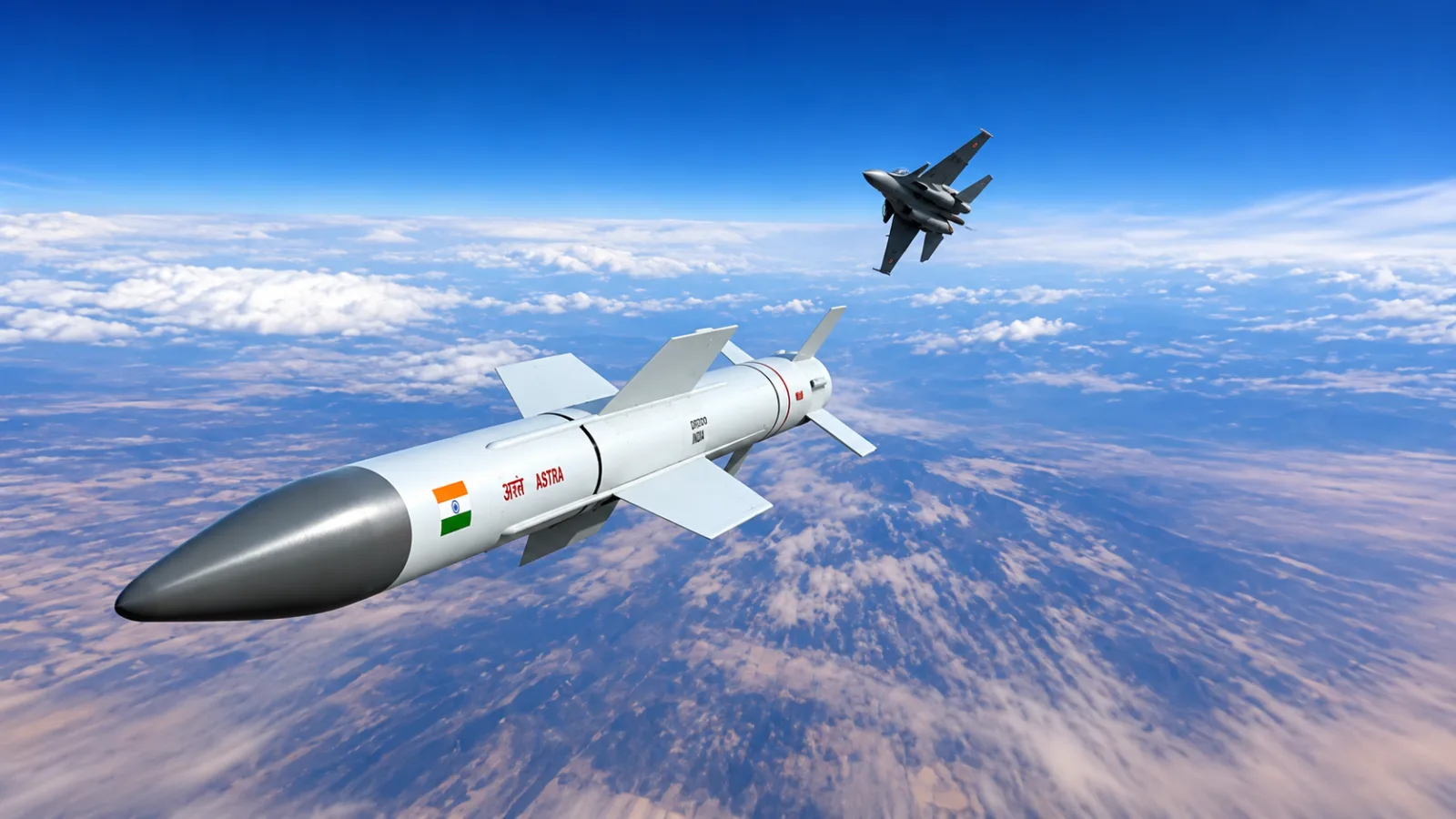
DRDO has showcased the indigenous Astra Mk1 air-to-air missile in South Africa as India looks for a larger role in the African defence market. Ethiopia, Uganda, Angola and Algeria have reportedly emerged as potential customers because all operate Su-30 fighters, but no African Astra contract has been announced and integrating the Indian missile onto different Sukhoi variants will be the decisive technical challenge.
India developed the Astra Mk1 to reduce its dependence on imported beyond-visual-range air-to-air missiles. It is now trying to turn that same technology into an export product for countries operating Russian-built fighters.
DRDO showcased the Astra Mk1 at the Africa Aerospace and Defence 2026 exhibition in Tshwane, South Africa, alongside systems including Akash-NG, airborne surveillance technologies and maritime sensors. DRDO said its participation was intended to highlight indigenous defence capabilities and strengthen international defence cooperation.
Recent specialist reporting has identified Ethiopia, Uganda, Angola and Algeria as potential African markets for Astra Mk1. All four operate variants of Russia's Su-30 fighter family.
The specific four-country export push, however, has not yet been confirmed through a public DRDO, Ministry of Defence or Bharat Dynamics announcement. There is also no publicly announced Astra contract with any of these four countries.
The distinction matters. India has a technically credible product and a logical customer base, but identifying potential operators is not the same as securing a missile order.
What makes the African push strategically interesting is something broader: India is attempting to sell an Indian weapon as an upgrade for fighter aircraft originally designed and exported by Russia.
Astra Has Already Crossed the Hardest Domestic Hurdle
Astra Mk1 is DRDO's indigenous beyond-visual-range air-to-air missile, developed around Indian Air Force requirements and produced by Bharat Dynamics Limited.
In 2022, the Ministry of Defence signed a ₹2,971 crore contract with BDL for Astra Mk1 missiles and associated equipment for the Indian Air Force and Navy.
More importantly for the African opportunity, the Ministry confirmed that Astra Mk1 was already fully integrated with the IAF's Su-30MKI.
That gives India something valuable when approaching foreign Sukhoi operators: it is not offering a missile that exists only as a standalone weapon.
India has already completed the difficult process of making Astra communicate with a Su-30's radar, mission computer, launcher and weapons-management architecture, and has conducted extensive flight testing from the platform.
The missile uses mid-course guidance before switching to an active radar seeker during the terminal stage of engagement. In July 2025, DRDO and the IAF successfully tested Astra with an indigenously developed radio-frequency seeker from a Su-30MKI. The Ministry of Defence describes the missile's range as exceeding 100 kilometres.
Some defence reporting places the engagement envelope at roughly 80 to 110 kilometres depending on launch conditions. Claims that an export version is being marketed specifically as exceeding 110 kilometres have not been publicly confirmed by DRDO, so the more defensible official figure remains over 100 kilometres.
Why These Four African Countries Make Sense
The logic behind targeting Su-30 operators is straightforward.
Algeria operates the Su-30MKA, one of the largest Sukhoi fleets in Africa. Janes confirmed the type remained operational in 2026 when Algeria deployed four Su-30MKAs to Niger.
Uganda operates Su-30MK2 fighters. Aviation-order-of-battle specialist Scramble lists six aircraft with the Uganda People's Defence Air Force.
Angola operates Su-30K aircraft acquired from Russia after originally being built for India. Satellite imagery examined by Bellingcat confirmed deliveries under Angola's 12-aircraft programme.
Ethiopia introduced Su-30K fighters in 2024. DefenceWeb reported that two aircraft were formally inducted, with the fighters believed to come from the batch originally manufactured for the Indian Air Force before being returned to Russia.
The Angola and Ethiopia connection is particularly unusual.
Some of the aircraft India could potentially arm with Astra today trace their history back to aircraft originally supplied to India before the IAF transitioned to the much more capable Su-30MKI.
India would effectively be offering an indigenous missile developed through its own Sukhoi experience to foreign air forces operating aircraft from the same wider family.
That creates a natural export opening, but not a plug-and-play solution.
A Su-30 Is Not Just a Su-30
The biggest obstacle is integration.
The Su-30 is a family of aircraft rather than a single identical configuration. India's Su-30MKI, Algeria's Su-30MKA, Uganda's Su-30MK2 and the older Su-30Ks operated by Angola and Ethiopia do not have identical avionics, radars or mission computers.
A modern BVR missile requires far deeper aircraft integration than simply attaching it to a compatible pylon.
Before launch, the fighter must pass target and engagement data to the weapon. After launch, the aircraft can provide mid-course updates before the missile's own active radar seeker takes over during the terminal phase.
That requires compatibility between the missile, launcher, mission computer, radar, datalink and weapons-management software.
Specialist reporting on Astra exports has therefore cautioned that fitting the missile to another country's Sukhoi could require software development, launcher adaptation, structural analysis, safe-separation testing and flight certification. Russian-origin aircraft may also be subject to technical-access and end-user restrictions involving the original manufacturer.
India's experience with the Su-30MKI reduces part of the technical risk. It does not eliminate it.
Each foreign variant would have to be assessed separately.
This may ultimately determine whether Astra becomes a widely exportable missile for the global Sukhoi fleet or remains limited to a smaller number of platforms where India can secure sufficient technical access.
Indonesia Has Already Opened the Door
Africa is also not India's first attempt to internationalise Astra.
Prime Minister Narendra Modi said in July that India and Indonesia had concluded a major agreement involving BrahMos and Astra missiles during his visit to Indonesia.
Indonesia itself operates Su-27 and Su-30 fighters, making it another example of India attempting to place Astra onto a Russian-origin combat-aircraft ecosystem.
That development matters because one successful foreign integration could make subsequent export campaigns easier.
Missile exports depend heavily on credibility. A foreign customer wants to know not only whether a weapon performs well during Indian trials, but whether it can be integrated, supported and sustained on its own aircraft.
If India can demonstrate that process with Indonesia, it creates a reference case when approaching other Sukhoi operators.
Africa could then represent the next stage of the export strategy rather than an isolated sales campaign.
India Is Targeting an Installed Russian Aircraft Base
This is where Astra's export potential becomes more significant than the four African countries currently being discussed.
Russia exported large numbers of Su-27 and Su-30-family aircraft over several decades. Operators exist across Asia, Africa and other regions.
Those aircraft create an installed market for missiles, upgrades, spares and maintenance.
Historically, buying a Russian fighter usually meant relying heavily on Russian weapons and technical support throughout the aircraft's operational life.
India now has the possibility of entering part of that lifecycle market.
It has spent decades operating, manufacturing and modifying the Su-30MKI. Indian companies have developed avionics, electronic systems, weapons and maintenance expertise around the platform.
Astra adds another layer: India can potentially offer an indigenous BVR weapon to countries that want to retain their Russian-built aircraft while diversifying their weapons supply.
That is a very different export proposition from selling a complete Indian fighter aircraft.
A country does not need to replace an entire fleet to buy Astra. It potentially needs only to modernise the weapons carried by aircraft it already owns.
That lowers the commercial threshold for India to enter a foreign air force.
Africa Is Becoming a Larger Defence Market for India
The Astra campaign also fits a wider Indian effort to deepen defence relationships across Africa.
India hosted the second India-Africa Defence Dialogue in 2022 with participation from 50 African countries, including defence ministers, military chiefs and senior officials. The Ministry of Defence described defence cooperation as an area of growing convergence between India and African states.
India has also expanded its overseas defence representation. The Ministry of Defence announced new Defence Wings in countries including Algeria and Ethiopia, strengthening institutional links in two of the markets now associated with the Astra opportunity.
The attraction for African buyers is potentially broader than price.
India can offer training, maintenance, upgrades and weapons for platforms that many African militaries already operate. In some cases, Indian systems can provide an alternative to relying entirely on Russia, Western suppliers or China.
For India, this creates an opportunity to move defence relationships from military training and diplomatic engagement towards long-term industrial support.
A missile sale is rarely a one-time transaction.
It can require training rounds, live missiles, test equipment, maintenance infrastructure, software support, future upgrades and replenishment orders.
An Astra customer could therefore become a defence partner for decades rather than merely a buyer for one contract.
The Real Export Opportunity Is the Ecosystem
Astra's importance should not be measured only by the number of missiles India eventually sells.
The larger opportunity is demonstrating that Indian industry can provide weapons and upgrades for foreign-origin military platforms.
That matters because much of the developing world's military inventory was not designed in India.
If Indian companies can only export systems for Indian-designed platforms, the addressable market remains limited. If they can integrate Indian missiles, radars, electronic warfare systems and avionics onto foreign aircraft, ships and armoured vehicles, the potential market becomes much larger.
The Su-30 is an ideal test case because India possesses unusually deep experience with the aircraft.
But the same principle could eventually apply elsewhere.
India's defence-export transition will become far more significant when it can sell not simply complete Indian products, but also upgrade packages for the enormous installed base of Russian and Soviet-origin equipment operated across Asia, Africa and the Middle East.
That is where Astra's African campaign becomes strategically interesting.
What Remains Unresolved
There is still a considerable distance between showcasing Astra in South Africa and seeing the missile under the wing of an Algerian, Ugandan, Angolan or Ethiopian Su-30.
No African order has been publicly announced.
The reported four-country target list has not been confirmed in an official DRDO or MoD statement.
The exact export configuration and pricing have not been publicly disclosed.
Most importantly, the technical integration requirements will differ between Su-30 variants.
Those factors could make negotiations lengthy even where political interest exists.
Yet the direction is significant.
Astra began as an attempt to give the Indian Air Force an indigenous alternative to imported BVR missiles. It has since entered production, gained an indigenous RF seeker, been integrated with India's Su-30MKI and moved into international defence marketing.
India is now testing whether that investment can create a second advantage: becoming a weapons supplier for aircraft it once depended on foreign countries to arm.
The next development to watch is not another exhibition appearance. It is whether one of these overseas Sukhoi operators enters a formal integration programme or procurement negotiation.
That would show that Astra has moved beyond being an Indian missile shown abroad and become a genuine export option for the wider Su-30 ecosystem.
Sources
Ministry of Defence, Government of India - 2022 Astra Mk1 production contract with Bharat Dynamics; confirms indigenous development, ₹2,971 crore procurement and full integration with the Su-30MKI. PIB: MoD contract for Astra Mk1
Ministry of Defence, Government of India - July 2025 Astra flight tests with the indigenous RF seeker; confirms Su-30MKI launch, indigenous seeker and official range of more than 100 km. PIB: Astra test with indigenous RF seeker
DRDO / RNA Media - supports DRDO's participation at Africa Aerospace and Defence 2026 and the display of Astra Mk1 in South Africa. RNA Media: DRDO showcases Astra Mk1 at AAD 2026
Prime Minister's Office, Government of India - confirms the government's statement that a major agreement involving Astra and BrahMos was concluded with Indonesia in July 2026. PIB: PM's July 2026 remarks on Astra and Indonesia
IDRW - specialist analysis of the technical and software challenges involved in integrating Astra Mk1 with foreign fighter variants, including Russian-origin Su-30 aircraft. IDRW: Astra export integration hurdles
Janes - confirms continued Algerian operation of the Su-30MKA through its 2026 deployment of Su-30 fighters to Niger. Janes: Algerian Su-30MKA deployment
Scramble - supports Uganda's operation of Su-30MK2 fighters. Scramble: Uganda Air Force order of battle
DefenceWeb - supports Ethiopia's induction of Su-30K fighters in 2024 and the reported connection to the earlier Indian Su-30 batch. DefenceWeb: Ethiopia acquires Su-30 fighters
Bellingcat - confirms Angola's acquisition and delivery of Su-30 aircraft under its 12-aircraft programme. Bellingcat: Angola's Su-30 deliveries
Ministry of Defence, Government of India - supports India's broader defence engagement with Africa, including the India-Africa Defence Dialogue and expansion of Indian Defence Wings in Algeria and Ethiopia. PIB: India-Africa defence engagement