
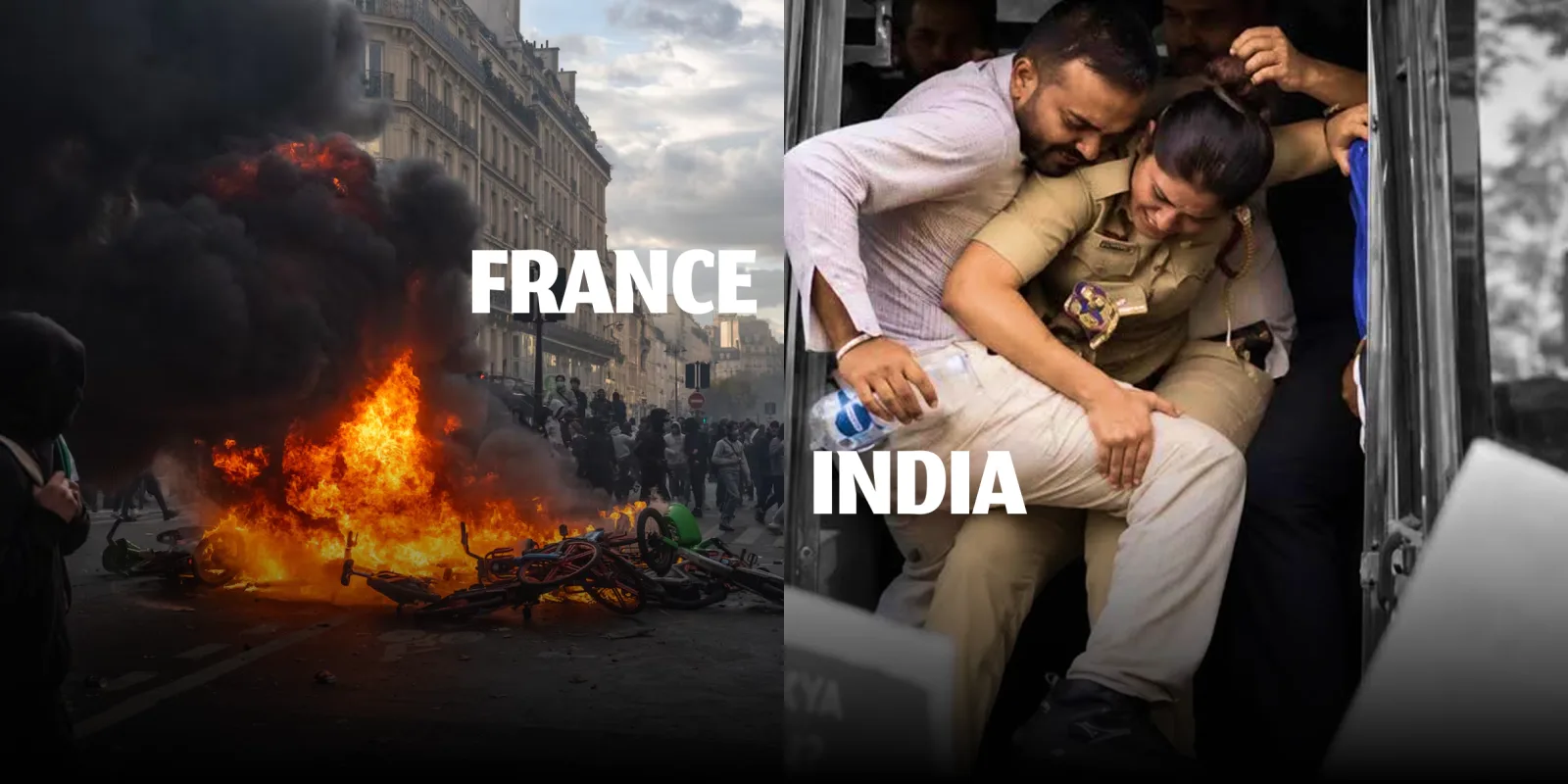
An investigation into France’s student unrest has mapped a network of unions, political organisations, ideological groups and international amplifiers extending far beyond the students who first took to the streets. Parts of the same ecosystem have also promoted demonstrations in India. The evidence does not establish one centrally controlled conspiracy, but it exposes a model India cannot afford to ignore: genuine local grievances can be captured, reframed and internationalised with remarkable speed.
France’s latest wave of student protests began with recognisable local grievances.
Students complained about deteriorating school conditions, teacher shortages, economic pressures and broader frustration with the government.
But what followed is far more significant than another European protest cycle.
A Fox News Digital investigation published on October 9 identified 50 organisations involved in organising, supporting or internationally amplifying the French demonstrations.
Only 15 were classified as student or youth organisations.
The remaining 35 included labour unions, communist and socialist groups, political parties, civil-rights organisations, advocacy networks and international media platforms.
That changes the nature of the story.
The question is no longer simply why French students are angry.
It is how quickly a local student grievance can be absorbed into a much larger ideological and political infrastructure.
A Student Protest That Became Much Bigger
The demonstrations may have started around education, but the political agenda surrounding them rapidly expanded.
Groups participating in or amplifying the movement began connecting student grievances with opposition to capitalism, austerity, policing, military expenditure, Israel and other international political causes.
This does not mean the original student grievances were manufactured.
That distinction is important.
A protest can begin organically and still be captured by actors with much broader objectives.
In fact, that may be the more effective model.
There is no need to manufacture public anger when genuine dissatisfaction already exists. An organised political ecosystem simply needs to attach itself to that anger, provide ideological framing, amplify selected narratives and connect one country's protest to movements elsewhere.
The grievance can be local. The political infrastructure around it can be global.
The India Connection
The investigation becomes particularly relevant for India because one of the organisations highlighted was Indian Alliance Paris, a France-based group of Indian students, researchers and professionals.
According to the investigation, the organisation publicly connected protests in France with demonstrations taking place in India.
One of its social-media messages addressed young protesters in both countries together:
“To Gen Z: In France. In India. Bravo for today.”
The group also amplified Indian political developments, including the detention of Leader of Opposition Rahul Gandhi during protests in New Delhi.
None of this, by itself, proves that Indian protests were directed from France.
It does establish something more concrete: political actors abroad were deliberately placing unrest in France and India inside the same international narrative.
That matters.
Once separate movements are packaged as manifestations of the same global struggle, each begins reinforcing the other.
Protests in Paris become proof that young people everywhere are rebelling.
Protests in Delhi become evidence that the same supposed political awakening has reached India.
International media and activist accounts circulate both.
The image created is no longer one country dealing with one political dispute.
It becomes a global wave.
How the Amplification System Works
This is where the word “ecosystem” becomes useful.
An ecosystem does not require one commander sitting in a room issuing instructions to every participant.
Different organisations can have different leaders, funding sources and immediate objectives while still reinforcing the same political narrative.
Student groups mobilise.
Trade unions increase street strength.
Political parties provide institutional backing.
Ideological organisations supply a wider interpretation.
Media platforms distribute dramatic footage.
Diaspora organisations internationalise the message.
Activists in other countries then present the unrest as part of their own struggle.
The result can resemble coordination even where there is no evidence of a single central command structure.
That distinction should make India more alert, not less.
Modern influence operations do not always require secret orders.
Sometimes amplification itself is the operation.
From France to the US, UK, Greece, Brazil and India
The October 9 investigation traced international amplification beyond France into countries including India, the United States, United Kingdom, Greece and Brazil.
Subsequent reporting by Fox expanded its mapping of the wider protest ecosystem even further.
The significance is not that everyone involved shares identical objectives.
They clearly do not.
The significance is that established international political networks possess the ability to move narratives across borders rapidly, creating solidarity between movements that originally emerged from completely different local circumstances.
A teacher shortage in France can therefore become part of a wider campaign against capitalism.
A domestic Indian electoral controversy can be placed beside European street unrest.
A protest over living costs can merge with campaigns over policing, foreign policy or Gaza.
The issue changes. The network remains.
This Is Where India Must Be Smarter
India should resist two equally dangerous reactions.
The first is to dismiss every concern about transnational political networks as conspiracy theory.
The second is to label every protest against the government as foreign-controlled.
Both are intellectually lazy.
India is a democracy.
Citizens have the right to protest, criticise the government, challenge the Election Commission, organise politically and demand accountability.
Young Indians do not need foreigners to tell them when they are angry.
But protecting democratic dissent does not require pretending international influence networks do not exist.
The state must be capable of distinguishing between an Indian citizen exercising a constitutional right and an organised network deliberately seeking to manipulate, finance, coordinate or amplify unrest for external political objectives.
That distinction can only be made through evidence.
Follow the financial flows.
Map organisational relationships.
Examine grants and institutional partnerships.
Identify coordinated messaging.
Study cross-border campaign material.
Track whether supposedly independent organisations repeatedly use the same narratives, resources and amplification channels.
Where laws are broken, enforce them.
Where no wrongdoing exists, do not manufacture it.
A confident democracy investigates networks. An insecure one criminalises disagreement. India must be the former.
The Foreign Amplification Loop
The larger danger lies in how quickly modern political narratives can acquire international legitimacy.
A domestic activist makes an accusation.
An international organisation amplifies it.
A foreign media platform reports the amplified allegation.
The foreign report is then brought back into the domestic debate as proof that “the world is watching”.
What began as a contested political claim suddenly appears internationally validated.
But repetition is not verification.
Fifty organisations repeating the same allegation do not necessarily make the allegation true.
A foreign newspaper publishing it does not transform it into evidence.
A viral protest video from another country does not prove that India faces the same political circumstances.
Narrative volume is not factual weight.
That principle matters increasingly in an era when political mobilisation travels across borders at the speed of social media.
No Grand Conspiracy Has Been Proven
This investigation should also not be stretched beyond what it establishes.
It does not prove that one organisation controls every protest.
It does not establish that every French demonstrator belongs to an ideological network.
It does not prove that demonstrations in India were engineered abroad.
And ideological overlap between organisations is not automatically evidence of illegal coordination.
Those claims would require much stronger evidence.
But dismissing the entire issue because there is no single command centre would miss the real lesson.
A sophisticated transnational political ecosystem does not necessarily need one.
Independent organisations can share ideology, personnel, funding relationships, campaign infrastructure and amplification channels while remaining formally separate.
What matters is understanding how those relationships shape political narratives.
India Must Learn the Right Lesson
The warning from France is not that protests are illegitimate.
The warning is that protests are no longer necessarily confined to the societies in which they begin.
A local grievance can become international content within hours.
Foreign activist networks can attach themselves to it.
Political organisations can broaden its demands.
International media can amplify its most dramatic interpretation.
Diaspora groups can connect it to unrest elsewhere.
And eventually, a dispute about schools, elections or economic policy can be presented as one front in a global ideological struggle.
India cannot respond by shutting down dissent.
It must respond by becoming better at identifying influence.
Let genuine democratic protest remain democratic protest.
But when money, organisations, messaging and political campaigns begin crossing borders, investigate them transparently and relentlessly.
India must never confuse dissent with destabilisation.
But it must be equally careful not to confuse organised influence with spontaneous dissent.
That distinction may become one of the defining national-security challenges of the information age.
Sources
- Fox News Digital - Behind France's Student Riots: Communists, Unions and a Global Propaganda Network - October 9, 2026 investigation identifying 50 organisations within the French protest ecosystem and its international amplifiers.
- Moneycontrol - France Riots, India Protests Linked to Same Global Network: Report - October 22, 2026 report summarising the France-India links, the 50 organisations and Indian Alliance Paris's role in cross-border amplification.
- Fox News Digital - Who's Who: Inside France's 'Chaos Inc' Franchise - Follow-up investigation expanding the mapping of organisations and identifying Indian Alliance Paris among international amplifiers.
- Fox News Digital - Global 'Chaos Inc' Grows to 101 Groups - Follow-up reporting describing the broader international expansion of the protest ecosystem across multiple countries.