
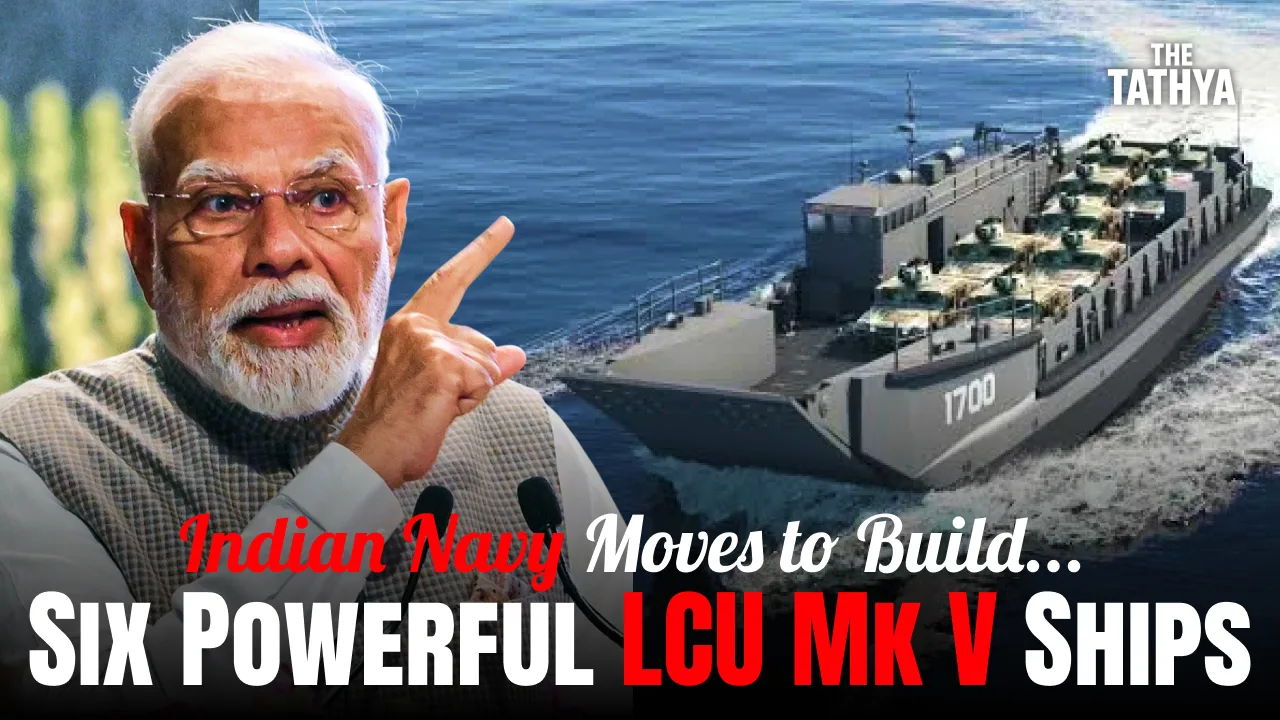
The Indian Navy has issued a Request for Information for six larger Landing Craft Utility Mk V vessels, with roughly three times the endurance of its existing Mk IV fleet. The proposed ships would strengthen the Navy’s ability to move armour, troops and supplies between distant islands, but the programme is still at an early procurement stage and should not yet be treated as a signed construction order.
The Indian Navy is planning a substantial upgrade to one of the less visible but strategically important parts of its fleet: the ships that move soldiers, tanks and supplies from sea to shore.
The Navy has issued a Request for Information, or RFI, to Indian shipyards for six Landing Craft Utility Mk V vessels. The proposed ships are expected to displace around 1,500 tonnes, measure roughly 85 metres in length and have an endurance of about 4,500 nautical miles.
They are also required to reach at least 15 knots and carry heavy military loads, including at least four main battle tanks, four BMP infantry fighting vehicles and around 190 troops, according to reporting based on the Navy’s RFI. The planned operational life is 30 years.
The numbers make the Mk V substantially more capable than the indigenous LCU Mk IV ships already in service.
But the most important difference is not simply displacement or troop capacity. It is range.
A landing craft capable of operating for about 4,500 nautical miles would give the Navy considerably more flexibility to reinforce distant islands, move heavy equipment between dispersed positions and support operations across a much wider section of the Indian Ocean.
A Much Larger Successor to the LCU Mk IV
The Indian Navy currently operates eight LCU Mk IV vessels built by Garden Reach Shipbuilders and Engineers.
The Mk IV was itself an important indigenous programme. The ships were designed by GRSE for the Navy and are used primarily for transporting tanks, armoured vehicles, troops and equipment from ship to shore.
Official Ministry of Defence records describe the Mk IV as an approximately 830-tonne vessel capable of carrying 160 troops, alongside main battle tanks and other vehicles. The class has been based largely under the Andaman and Nicobar Command and used for beaching operations, island supply, search and rescue, evacuation and disaster relief.
GRSE records give a further indication of the existing class’s operating envelope. The Mk IV is approximately 62.8 metres long, capable of around 15 knots and has an endurance of roughly 1,500 nautical miles at 12 knots.
The proposed Mk V represents a clear increase in scale.
At approximately 85 metres and 1,500 tonnes, it would be longer and significantly heavier than the Mk IV. More importantly, its specified endurance of around 4,500 nautical miles is roughly three times that of its predecessor.
That changes how the vessel can be used.
The Mk IV has proved useful as an amphibious connector and island-support platform. The Mk V requirement points towards a vessel expected to perform similar missions over considerably greater distances and with a heavier payload.
Why 4,500 Nautical Miles Matters
Landing craft are often associated with a simple image: troops and vehicles being carried directly onto a beach.
That remains a central function, but India’s geography gives such ships another role.
The country has strategically important island territories spread across two very different maritime theatres. The Andaman and Nicobar Islands sit close to major sea lanes connecting the Indian and Pacific Oceans, while Lakshadweep lies in the Arabian Sea.
Sustaining military positions on islands requires a continuous movement of vehicles, engineering equipment, ammunition, stores and personnel.
The existing LCU fleet already performs this kind of work. GRSE has explicitly described the Mk IV as designed for amphibious operations involving the Andaman and Nicobar and Lakshadweep island chains.
A 4,500-nautical-mile endurance would provide much greater flexibility in how such missions are organised. The Mk V could spend longer at sea, travel farther without replenishment and support more widely dispersed operations.
That does not make it a replacement for a large amphibious assault ship.
An LCU lacks the aviation facilities, command infrastructure, troop capacity and broader combat systems of a Landing Platform Dock or amphibious assault vessel. Its strength lies instead in moving heavy loads directly to coastlines and islands where larger ships may not be able to berth.
That distinction is important. The Mk V would expand India’s tactical and operational sealift, not by itself create a large expeditionary amphibious force.
Heavy Armour Can Move With the Troops
Payload is the other major feature of the requirement.
Reporting on the RFI says each Mk V must be capable of carrying at least four main battle tanks, four BMP infantry fighting vehicles and 190 troops.
That gives commanders the ability to move a meaningful package of mechanised forces to an island or coastal position without relying entirely on conventional ports.
The value is most obvious in reinforcement.
If an isolated position requires additional troops and armour, an LCU can move the equipment and then beach itself to unload directly. The same characteristics are useful for engineering vehicles, trucks and disaster-relief supplies.
India has already used the existing Mk IV class for roles well beyond combat. Ministry of Defence records identify search and rescue, supply and replenishment, evacuation from distant islands and humanitarian assistance and disaster relief among its missions.
The Mk V requirement retains that multi-role logic.
Reports based on the RFI also identify island logistics, EEZ patrols, search and rescue and HADR among the intended tasks. The proposed ships are expected to operate in Sea State 3 and survive conditions up to Sea State 7, indicating that the Navy expects them to function beyond sheltered coastal waters.
The Andaman and Nicobar Dimension
The Mk V requirement is particularly relevant to the Andaman and Nicobar Command.
The existing Mk IV fleet was built with the island command in mind. The islands stretch across a long north-south chain and are separated from the Indian mainland by hundreds of kilometres of sea.
That makes logistics a military capability in its own right.
Aircraft can move personnel and light cargo quickly, but heavy armour, large vehicles, fuel, construction machinery and bulk supplies still depend heavily on sea transport.
LCUs offer an additional advantage because they can operate in places with limited port infrastructure.
This makes them useful not only during conflict, but also when infrastructure is damaged by cyclones, earthquakes or other disasters.
The proposed Mk V's greater endurance could therefore strengthen the Navy’s ability to shift resources between the mainland, the island chains and other positions across the eastern Indian Ocean without treating every movement as a short-range coastal mission.
This is where the phrase “amphibious capability” can sometimes be misunderstood.
India does not need landing craft only to conduct hostile beach assaults. It also needs them to sustain its own dispersed territory.
For an archipelagic command such as Andaman and Nicobar, logistics and deterrence are closely connected. A military position is strategically valuable only if India can reinforce and resupply it when required.
An Indigenous Shipbuilding Requirement
The Navy intends the procurement to proceed under the Buy (Indian-IDDM) category.
Under the Defence Acquisition Procedure 2020, Buy (Indian-IDDM) is the highest-priority normal acquisition category and applies to products procured from Indian vendors that are indigenously designed, developed and manufactured with the stipulated indigenous content. The baseline requirement under DAP 2020 is at least 50% indigenous content on the cost basis defined by the procedure.
For the LCU Mk V programme, that matters because India already possesses an indigenous design and construction base for this type of vessel.
GRSE designed and built all eight Mk IV ships, with the programme progressively incorporating Indian equipment and systems. GRSE reported that the Mk IV class incorporated close to 90% indigenous equipment fit in later ships.
The Mk V requirement could deepen that capability further, particularly in naval architecture, propulsion integration, communication systems, sensors, machinery and shipboard automation.
However, the shipyard has not yet been selected.
GRSE's experience with the Mk IV naturally makes it relevant to the programme, but the RFI is addressed to Indian shipyards more broadly. Until the procurement moves through subsequent stages, it would be premature to identify a winner.
An RFI Is Not a Contract
This is the most important limitation in interpreting the announcement.
The Navy has issued an RFI, not a final Request for Proposal or construction contract.
An RFI is used to establish what industry can offer, assess potential vendors, refine technical requirements and gather information before a procurement moves into later stages.
The Navy itself has reportedly told shipyards to treat the RFI as advance information so that they can assess clearances, manpower and infrastructure requirements.
No final contract value, selected shipyard or delivery schedule has yet been publicly disclosed.
The correct description, therefore, is that the Indian Navy plans to acquire six LCU Mk V ships and has begun the industry-engagement stage.
India is not yet building six Mk V vessels.
That will depend on approvals, final specifications, competitive procurement and an eventual contract.
The Real Upgrade Is Strategic Mobility
If the programme proceeds broadly as outlined, the LCU Mk V would not be among the Indian Navy’s most heavily armed or glamorous new ships.
Its importance would come from something more basic: the ability to put military weight where India needs it.
Naval power depends not only on destroyers, submarines, aircraft carriers and missiles. It also depends on whether forces can be moved, supplied and sustained across the maritime theatre.
The Mk V requirement reflects that reality.
Its larger hull increases payload. Its tank and troop capacity improves amphibious lift. Its beaching role allows heavy equipment to reach areas without sophisticated port facilities.
But the defining upgrade is the 4,500-nautical-mile endurance requirement.
Compared with the roughly 1,500-nautical-mile endurance of the Mk IV, that points towards a Navy seeking landing craft that can operate much more independently across the Indian Ocean rather than remaining primarily short-range island connectors.
The development should still be kept in proportion. Six LCUs would not by themselves give India a large expeditionary amphibious warfare capability, and the programme has not yet reached the contracting stage.
What they could provide is a stronger layer of operational mobility beneath India’s larger warships.
For a country with distant island territories, a vast Exclusive Economic Zone and growing security responsibilities across the Indian Ocean, that logistical depth can be as strategically important as firepower.
The next development to watch is whether the RFI proceeds to a formal acquisition programme with finalised specifications, funding and a Request for Proposal.
Until then, the Mk V remains a planned capability.
But the requirement already reveals what the Navy wants from its next generation of landing craft: not merely a bigger Mk IV, but a vessel able to carry Indian troops, armour and supplies much farther across India’s maritime geography.
Sources
Ministry of Defence, Press Information Bureau - official specifications and operational roles of the existing LCU Mk IV fleet, including displacement, troop capacity and deployment under the Andaman and Nicobar Command. PIB: Commissioning of LCU Mk IV L52
Times of India - reports details attributed to the Indian Navy RFI, including six vessels, intended Buy (Indian-IDDM) categorisation, 1,500-tonne displacement, four MBTs, four BMPs, 190 troops, 15-knot speed and approximately 4,500-nautical-mile endurance. Times of India: Indian Navy plans six LCU Mk V vessels
The Defense News - additional reporting based on the RFI covering the approximately 85-metre length, Sea State requirements, 30-year planned service life and intended roles including island logistics, EEZ patrol, SAR and HADR. The Defense News: Indian Navy LCU Mk V RFI