
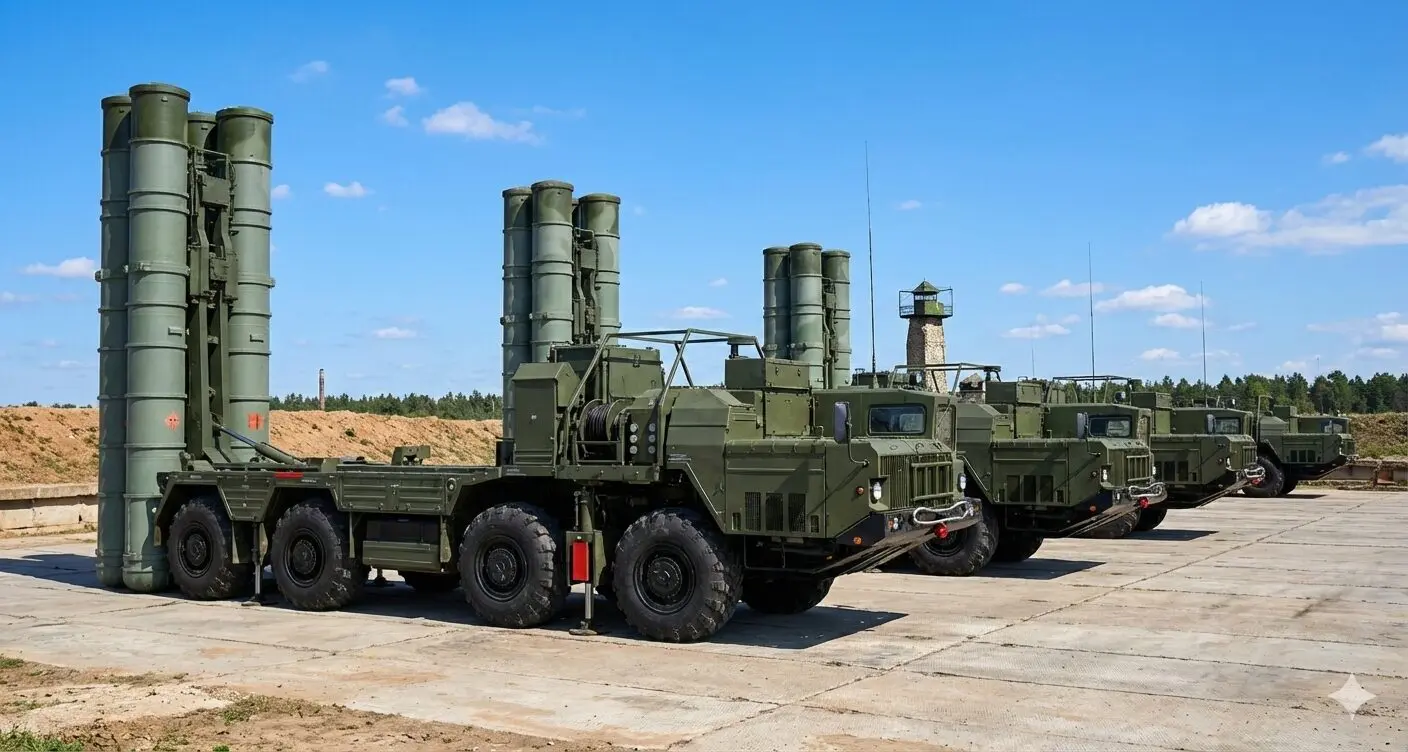
Russia is reportedly willing to offer India access to the S-500 Prometheus, potentially including technology transfer, Indian manufacturing and even re-export rights, if New Delhi proceeds with five additional S-400 systems. No S-500 agreement has been announced, but the proposal raises a much bigger question for India: buy another world-class foreign shield, or use the opportunity to acquire technology that permanently strengthens Indian capability?
Russia has reportedly placed one of its most ambitious air-defence proposals before India yet.
According to defence-media reports, Moscow is willing to discuss supplying India with the S-500 Prometheus and transferring technology for its manufacture if New Delhi proceeds with a follow-on purchase of five additional S-400 units. Some reports have also mentioned possible joint production and future re-export rights.
But the most important distinction comes first.
India has not ordered the S-500. No final price, delivery schedule, technology-transfer package or manufacturing arrangement has been officially announced.
What exists today is a potentially significant Russian proposal, not a signed Indian acquisition.
The S-400 Deal Is Already Moving Forward
The proposal comes at a time when India is already considering a substantial expansion of its S-400 fleet.
In March 2026, the Defence Acquisition Council cleared the procurement of five additional S-400 long-range surface-to-air missile systems. Russia later submitted its proposal, with the project estimated at more than ₹50,000 crore.
India's original 2018 contract covered five S-400 units. Four have been delivered, with the remaining system expected by the end of 2026, according to Russian statements.
If another five are eventually contracted, India could effectively double the size of its S-400 force.
But the reported Russian pitch goes significantly further.
Instead of merely selling India another imported system, Moscow is now said to be linking the follow-on S-400 package with possible access to the much newer S-500.
That is where this stops being merely another missile purchase and becomes a technology question.
What Makes the S-500 Different?
The S-500 Prometheus is designed as a higher layer of Russia's air and missile-defence architecture.
Open-source assessments describe the system as being intended to engage ballistic missiles, aircraft, cruise missiles and potentially some targets in near-space. Reported interceptor ranges extend to roughly 500-600 km for certain target sets, although some of its most ambitious claimed capabilities remain difficult to independently verify.
Russia has also promoted the S-500 as a system capable of confronting emerging hypersonic threats.
For India, this matters because the future air threat is rapidly changing.
The problem is no longer simply enemy fighters crossing the border.
India increasingly has to prepare for ballistic missiles, long-range cruise missiles, stealth aircraft, unmanned systems, high-speed weapons and potentially hypersonic platforms arriving through multiple vectors simultaneously.
A serious national air-defence architecture therefore has to be layered.
The S-400 already gives India a formidable long-range layer.
The S-500 could potentially sit above it.
But India Should Not Buy Another Black Box
This is where New Delhi should be uncompromising.
India does not need another expensive foreign weapons system that remains permanently dependent on the original manufacturer for critical components, upgrades and deep maintenance.
If the S-500 proposal is real, technology transfer should be the centre of the negotiation, not an attractive footnote.
India should seek access to manufacturing processes, interceptor technologies, radar architecture, command-and-control integration, maintenance capability and the maximum technically possible level of subsystem localisation.
Simply assembling imported kits in India should not qualify as meaningful technology transfer.
Neither should screwdriver manufacturing dressed up as Aatmanirbhar Bharat.
India's experience with Russia shows that deeper cooperation is possible. Su-30MKI aircraft and T-90 tanks have been produced under licence, while BrahMos represents a far deeper model of joint technological development. The S-400, by contrast, has remained a direct procurement rather than a jointly produced system.
The benchmark for an S-500 arrangement should therefore be clear:
India must emerge from the deal knowing how to build more of the capability itself.
Project Kusha Cannot Become the Casualty
There is another strategic consideration.
India is already developing its own long-range air-defence system under Project Kusha.
And Kusha is no longer simply a paper programme.
DRDO successfully conducted the maiden flight test of the Kusha long-range surface-to-air missile in July 2026 against a simulated high-speed, high-altitude aerial threat. DRDO says the indigenous system is being developed to engage fighters, missiles, UAVs and other aerial targets.
That changes how India should evaluate the S-500.
A Russian system could provide capabilities India needs earlier than an indigenous programme can deliver them.
But importing the world's most advanced air-defence hardware makes little strategic sense if it delays or weakens the indigenous system intended to eliminate that dependency.
S-500 should complement Kusha, not kill it.
If Moscow is genuinely prepared to transfer high-value technology that can accelerate Indian radar, interceptor and missile-defence development, there is a powerful argument for examining the proposal.
If the offer ultimately amounts to another largely imported system with limited Indian access to its core technologies, the strategic calculation changes completely.
India Should Negotiate From Strength
India is no longer negotiating as a desperate buyer looking for any available air-defence system.
It already operates the S-400.
It is expanding indigenous missile programmes.
It has Akash variants, MRSAM, ballistic missile-defence technologies and now Project Kusha moving forward.
That gives New Delhi leverage.
Russia wants another major Indian order.
India should use that leverage ruthlessly.
If five additional S-400 units are worth billions of dollars to Moscow, New Delhi should demand something transformative in return.
Real technology.
Deep localisation.
Indian maintenance sovereignty.
Domestic production.
Integration rights.
Long-term availability of spares.
And where feasible, export freedom.
India's objective should not be to own the S-500. It should be to absorb the capabilities behind it.
The Final Test Is Strategic Independence
The reported Russian proposal deserves serious consideration because India's threat environment demands an exceptionally strong multi-layered air-defence network.
But the biggest weapon purchase is not automatically the smartest one.
India's long-term objective cannot be an endless cycle in which every new generation of foreign threat requires another generation of foreign interceptor.
The real victory would be different.
Use the S-400 where India needs immediate operational strength.
Evaluate the S-500 where it provides a genuine technological leap.
Extract every possible piece of useful technology.
Feed that knowledge into Indian industry and indigenous programmes.
And continue accelerating Project Kusha until India's highest layers of air defence no longer depend on somebody else's permission, factory or geopolitical calculation.
India needs the strongest shield it can build.
But the shield must eventually be Indian.
Sources
Press Information Bureau - Defence Acquisition Council Approvals, March 2026 - Official Government of India source covering the acquisition process for additional S-400 long-range air-defence systems.
Press Information Bureau - DRDO Conducts Maiden Flight Test of Project Kusha Missile - Official source on the development and first flight test of India's indigenous long-range air-defence system under Project Kusha.
CSIS Missile Threat - S-500 Prometheus - Technical overview of the S-500, including its intended missile-defence role, reported interception ranges and target classes.
Press Information Bureau - India-Russia Defence Cooperation - Government source on broader India-Russia defence cooperation and joint-production programmes.